A modern car is built to protect you, but only if you use its safety equipment the way it was designed. This chapter covers the car’s protective shell, seats and head restraints, seat belts, airbags and child seats, then the natural laws that decide how quickly you can stop, how fast you can take a bend and how a car behaves on a slope or under load.
About 25 minutes
10 sections
Handbook Chapter 8, pp. 159–173
Chapter 8 · 10 sections
After this chapter you can
Explain what deformation zones do and why side impacts are harder to protect against.
Set the seat and head restraint to protect your neck, and load the car safely.
Wear a seat belt correctly and explain why rear-seat belts matter as much as front ones.
Describe how an airbag works with the seat belt and why children must be kept away from it.
Describe how the handbook says children should travel in a car.
Work out stopping distance from thinking distance and braking distance, and explain how speed changes each.
Explain how centrifugal force, gravity, oversteer and understeer affect control of the car.
Section 1 of 10
The car’s protective shell
The bodywork is designed to soak up crash forces at the front and back. The sides are harder to protect.
Source: Handbook §8.1.1, p. 159
Note
Safety systems only work if you use them properly
Modern cars have a high standard of safety systems, often several independent ones working together. The handbook’s key point is that they must be used in the way they were designed to function. When they are, the risk of fatal injury in an accident falls dramatically.
Source: Handbook §8.1, p. 159
Definition
Deformation zones
The front and back sections of the bodywork have deformation zones. In an accident they absorb much of the force of the impact, which reduces the effect on the driver and passengers.
The handbook contrasts this with older models and big 4WD cars, where the occupants take a higher percentage of the force of a collision.
Source: Handbook §8.1.1, p. 159
Important
Side impacts are harder to protect against
Protecting the occupants when a car is hit from the side is more difficult. Some cars have side impact protection, but injuries to the upper body and head in side impact collisions can still be particularly serious.
Source: Handbook §8.1.1, p. 159
Section 2 of 10
Seat, head restraint and loading
Sit close to the backrest, set the head restraint to protect your neck, and never leave heavy objects loose.
Source: Handbook §8.1.2, p. 160
Rule
The head restraint protects against whiplash
The head restraint is designed to reduce the risk of head and neck injury if you run into the rear of the car in front, or if someone runs into you from behind. These are known as whiplash injuries.
Set it so that it reaches to the top of your head. For tall people the handbook accepts about the middle of the back of the head.
Source: Handbook §8.1.2, p. 160
Steps
Protect your neck: how to sit
The handbook gives three steps for the seat before you drive.
1Sit close to the backrest and the head restraint.
2Adjust the backrest.
3Set the head restraint so that it reaches to the top of your head.
Source: Handbook §8.1.2, p. 160
Rule
Pack properly
Never keep heavy objects loose in the car. Place your cargo as low as possible, and use the seat belts to secure cargo carried on the back seat.
Source: Handbook §8.1.2, p. 160
Section 3 of 10
Seat belts save lives
The seat belt is the most important piece of safety equipment in the car, in the back seat as much as the front.
Source: Handbook §8.1.3, p. 161
Rule
The most important safety equipment in the car
The handbook calls seat belts absolutely the most important piece of safety equipment in the car, in both the front and the back seats. It says that if everyone used them, hundreds of lives could be saved every year in the UAE.
Its summary: your seat belt is your life insurance.
Source: Handbook §8.1.3, p. 161
Important
Back-seat belts protect the people in front too
In an accident, rear-seat passengers are liable to be hurled forwards. They injure not only themselves but the driver and front-seat passenger as well. A person sitting in the front could be killed when the rear passenger is thrown forward.
The handbook gives the driver the responsibility of ensuring that all passengers wear their seat belts, and expects adults to belt up without having to be told.
Source: Handbook §8.1.3, p. 161
Steps
How to wear the belt
A tight-fitting belt gives more protection than a loose one, and an incorrectly worn belt may make an injury worse.
1Tighten the belt. A properly tightened belt protects better.
2Check that the belt is not twisted.
3The diagonal belt should run smoothly across the shoulder without constricting the throat, the neck or the top of the arm.
4The lap belt should fit snugly over the hips rather than the stomach.
5Some new cars have a seat belt pretensioner (tensioner) that tightens the belt automatically in a crash.
Source: Handbook §8.1.3, p. 161
Example
Would you dare do this?
To show how violent even a low-speed crash is, the handbook compares collision speeds with falls.
Falling full length to the floor from a standing position: about 7 km/h, which it gives as the most your arms can withstand.
Falling the same way from a chair: equivalent to a speed of 15 km/h.
Throwing yourself off the top of a three-storey building without a safety net: equivalent to colliding with an object at 50 km/h.
Source: Handbook §8.1.3, p. 161
Section 4 of 10
Airbags (SRS)
An airbag adds to the seat belt; it never replaces it. It opens with great force, which makes it dangerous for children.
Source: Handbook §8.1.4, p. 162
Definition
A supplement to the seat belt
SRS stands for Supplementary Restraint System. The airbag is a valuable supplement to the seat belt: together with the belt it gives extra protection against injuries.
An airbag is not a soft, billowy pillow. To do its job it comes out of the dashboard faster than the blink of an eye.
Source: Handbook §8.1.4, p. 162
Rule
Who can sit where there is an airbag
The handbook says a passenger must be at least 145 cm tall and be wearing a seat belt to travel safely where there is an airbag.
A child riding in the front seat can be seriously injured or killed when an airbag comes out in a crash.
Source: Handbook §8.1.4, p. 162
Section 5 of 10
Children in the car
Children need a seat made for their size, mounted correctly, in the back of the car and never in front of an airbag.
Source: Handbook §8.1.5, pp. 163–165
Important
Never carry a child on your lap
It does not take much force to injure a child: the handbook’s example is sudden braking or a collision at 40 km/h. Every year children are killed or injured because they were not properly fastened in the car.
A child on the driver’s lap will, in an accident, be trapped between the steering wheel and the driver’s body, which hits with a force equal to several times the driver’s actual weight. A child should never sit on the knee of an adult in the car either, and must never be turned into a "human airbag".
Source: Handbook §8.1.5, pp. 163–164
Rule
Children need their own type of seat
Seat belts are normally designed for adults, so a car must be fitted with a safety seat for a child to travel safely. Mounting the child seat on the rear seat gives a high degree of protection.
Change the type of seat as the child grows. The child’s size decides when to switch.
Follow the manufacturer’s instructions exactly and anchor the seat securely to the anchor post the manufacturer provides.
The handbook warns strongly about badly fitted seats: it says improper mounting is far more dangerous than not using a child seat at all.
If the child cannot be protected in the correct way, the handbook says it is best to put the child in the back seat with a seat belt.
Source: Handbook §8.1.5, p. 163
Rule
Rear-facing is best for young children
The handbook says rearward facing is the best way to mount a child seat. Up to the age of approximately 4 years it is much safer for a child to travel facing rearwards, because a rearward-facing seat absorbs the violent shocks and protects the child’s sensitive head and neck.
Do not turn the child around too soon. If the seat’s rear-facing weight and height limits allow, keep the child facing the rear to reduce the risk of cervical spine (neck) injury.
The top of a rear-facing child’s head should be at least 1 inch below the top of the child seat’s shell.
Source: Handbook §8.1.5, pp. 163, 165
Important
Never in front of an airbag; the back is safest
Under no circumstances should an infant seat, rear-facing car seat, booster seat or cushion be placed in front of a passenger’s airbag. The handbook describes the risk of severe injury or fatality as extremely high.
The safest place for children is in the back of the car. That stays true even if the airbag is shut off or there is no airbag at all.
Source: Handbook §8.1.5, p. 164
Rule
Check against current rules
What the handbook says the law requires
The 2018 handbook states that UAE law requires all children under the age of ten to be located in the rear seat of a car, wearing a seat belt or secured in a protective seat, and that they should never ride in the front seat.
Laws change. This is the rule as the handbook printed it in October 2018, so check the current requirement with your instructor or the licensing authority.
Source: Handbook §8.1.5, p. 164Legal requirement as stated in the October 2018 handbook; not checked against current law.
Check against current rules. This point could not be fully verified or may have changed since the 2018 handbook.
Note
Check against current rules
The seat types the handbook recommends
The handbook lists these seat types under "Recommended". The ages are approximate, and the child’s size is what decides when to move on.
Infant seat (a small, lightweight safety seat): up to around 9 months. Described as the safest way for the youngest passengers to travel.
Rear-facing car seat: from around 9 months to around 4 years of age.
Booster seat or cushion, used with the seat belt: from around 4 years of age up to age 10–12.
American-style forward-facing seat with a full harness: listed as an alternative to the rear-facing seat from age 1 or 10 kg, until outgrown at around 18 kg.
Source: Handbook §8.1.5, p. 165Recommended ages overlap, and page 163 says the forward-facing seat does not give the protection of a rear-facing one.
Check against current rules. This point could not be fully verified or may have changed since the 2018 handbook.
Section 6 of 10
Forgetting children in the vehicle
A child left in a car heats up far faster than an adult. It can kill.
Source: Handbook §8.1.6, p. 166
Important
Never leave a child in the car
Forgetting children inside the vehicle is dangerous for them and sometimes results in suffocation and death. The reason the handbook gives is that a small body heats up 3 to 5 times faster than an adult’s body in the same circumstances.
Source: Handbook §8.1.6, p. 166
Note
Check against current rules
The penalty the handbook quotes
The handbook quotes Article 350 of the UAE federal penal code: detention, or a fine not exceeding ten thousand dirhams, for whoever personally or through others exposes to danger a child who has not completed seven years of age.
This is the wording printed in the 2018 handbook. The law and the penalty may have changed since then.
Source: Handbook §8.1.6, p. 166Penalty as quoted in the October 2018 handbook; the quoted wording is unclear and has not been checked against current law.
Check against current rules. This point could not be fully verified or may have changed since the 2018 handbook.
Section 7 of 10
Stopping distance
Stopping distance is thinking distance plus braking distance. Speed lengthens both, and braking distance far more.
Source: Handbook §8.2.1, pp. 167–168
Illustrated
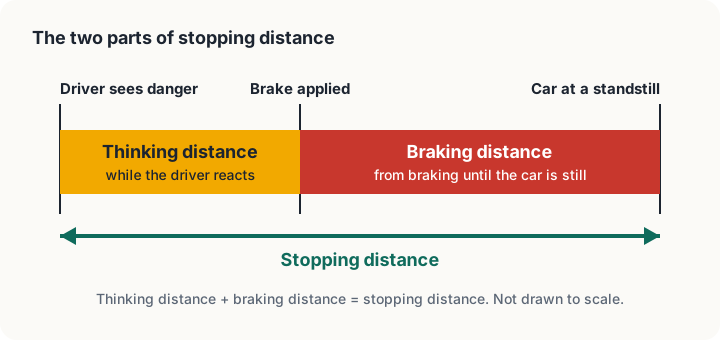
Fig. Figure 8.1Stopping distance = thinking distance + braking distance. Original illustration, based on Handbook §8.2.1, p. 167
The stopping distance is the distance the car travels from the moment the driver sees danger ahead until the car comes to a complete standstill. It has two parts, and you add them together.
Thinking distance: the distance the car travels while the driver is reacting to the possible danger.
Braking distance: the distance the car travels from the moment you step on the brake until the moment it is still.
Source: Handbook §8.2.1, p. 167
Rule
Thinking distance
Thinking distance depends on two things: your speed and how quickly you react. A normal reaction time is one second. In that second a car travelling at 40 km/h covers 12 metres, and at 80 km/h it covers 24 metres.
Beginner drivers often take longer to react. An experienced driver has already identified the danger and prepared to brake, so their thinking distance is shorter.
The handbook’s approximate figures for one second: 40 km/h, 12 m. 60 km/h, 18 m. 80 km/h, 24 m. 100 km/h, 30 m. 120 km/h, 36 m.
The table shows each figure as 3 times the speed in tens of km/h: for 80 km/h, 3 × 8 = 24.
Source: Handbook §8.2.1, p. 167
Note
What braking distance depends on
The car is still moving all the time you are braking. How far it goes depends on six things.
Your speed.
The state of the road.
The gradient.
The condition of your brakes.
The condition of your tyres.
Your braking technique.
Source: Handbook §8.2.1, p. 168
Illustrated
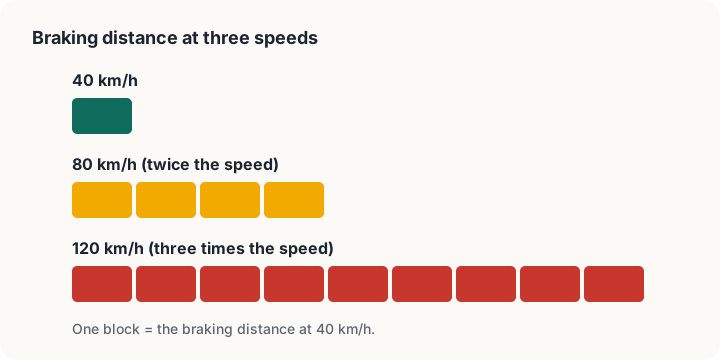
Fig. Figure 8.2Braking distance grows with the square of speed. Original illustration, based on Handbook §8.2.1, p. 168
Braking distance grows with the square of speed
A moving car carries kinetic energy, the energy caused by its movement. Because of this, braking distance increases as the square of the increase in speed.
Twice the speed: 4 times the braking distance (2 × 2). Going from 40 to 80 km/h makes it four times as long.
Three times the speed: 9 times the braking distance (3 × 3). Going from 40 to 120 km/h makes it nine times as long.
Four times the speed: 16 times the braking distance (4 × 4).
Source: Handbook §8.2.1, p. 168
Steps
Ways to brake
How you brake changes how far the car travels before it stops.
1Show foresight: easing off the accelerator in plenty of time spares the brakes and makes you a safer driver.
2Brake firmly right at the start. This cuts the braking distance and increases your safety margin.
3Be prepared: keeping your foot poised above the brake pedal, ready to react, can shorten your stopping distance.
4In an emergency, brake hard immediately but without locking the wheels.
5If the wheels do lock and the car has no ABS (antilock braking system), reduce the brake pressure as quickly as possible.
Source: Handbook §8.2.1, p. 168
Section 8 of 10
Centrifugal force: when the road bends
A car wants to carry straight on. Only the grip of the tyres takes it round the bend, so speed must match the grip.
Source: Handbook §8.2.2, p. 169
Definition
Why a car tries to go straight on
A moving car tends to travel straight forwards even though the road curves. Turning the steering wheel forces it away from that straight line. The force set up as the vehicle takes the bend is the centrifugal force.
It must never become so great that the tyres lose their grip. If you drive too fast, the grip (friction) of the tyres on the road will not be enough to keep the car on course.
Source: Handbook §8.2.2, p. 169
Rule
Slow in, gently out
Slow down as you approach a bend and accelerate gently out of it.
Read the road as far ahead as possible.
Stay alert for sharp bends and sudden changes in the road surface.
A patch of wet leaves, for instance, may be very slippery.
Source: Handbook §8.2.2, p. 169
Section 9 of 10
The force of gravity
On a steep downhill slope gravity works against your brakes. Use the engine to hold the car back.
Source: Handbook §8.2.3, p. 169
Rule
Steep downhill: let the engine do the work
Anyone who has braked a bicycle on a steep hill knows how hard gravity makes it. The same force acts on cars. Sometimes a sign will warn you that the road ahead slopes steeply downhill, so take it easy.
It may be necessary to change down a gear, in automatic as well as manual gearboxes, and let the engine do the work. The alternative is to risk overheating the brakes or losing control of the car.
Source: Handbook §8.2.3, p. 169
Section 10 of 10
Handling different cars
Two cars that look alike can behave very differently. Weight at the front or the rear changes how a car steers.
Source: Handbook §8.3, pp. 170–171
Steps
Before you drive a car you do not know
Front-wheel-drive, rear-wheel-drive and four-wheel-drive cars may look very similar and still behave quite differently. The handbook asks you to think about these points first. It poses them as questions and leaves the answers to you.
1How important is the condition of the tyres to the way the car handles?
2How well does the brake system work in emergency braking?
3How does driving differ with different transmissions?
4How does the car react if the shock absorbers are in poor condition?
5How does the load it is carrying affect the car’s stability?
Source: Handbook §8.3.1, p. 170
Definition
Oversteer
Oversteer means the car responds to the steering more than expected. If it loses its grip on the road it may go into a spin.
A heavy weight in the rear of the vehicle can cause it. Even a car that normally understeers may oversteer in some situations, for example when it is carrying a heavy load.
Source: Handbook §8.3, p. 171
Definition
Understeer
Understeer occurs when traction is lost at the front wheels while cornering. The car is forced wide on the bend even though you have applied the correct steering angle.
A car with its engine mounted at the front normally has a forward weight that makes it understeer: it tends to continue forwards in a straight line when you take a bend.
Source: Handbook §8.3, p. 171
Chapter 8 recap
Remember this
Deformation zones at the front and back absorb much of the force of an impact.
Head restraint to the top of your head; sit close to the backrest. It protects against whiplash.
Seat belts matter as much in the back as in the front. Wear them tight, untwisted, with the lap belt over the hips.
An airbag (SRS) supplements the seat belt. The handbook’s minimum for sitting by one: 145 cm tall and belted.
Never put a child seat in front of a passenger airbag, and never carry a child on your lap.
Normal reaction time is one second: about 12 m at 40 km/h and 24 m at 80 km/h.
Twice the speed means four times the braking distance; three times the speed means nine times.
Slow down before a bend and accelerate gently out. On a steep descent, change down and let the engine do the work.
Common misconceptions
Myth
: Passengers in the back seat do not really need a seat belt.
Fact
: The handbook says the belt is just as important in the back seat as in the front. An unbelted rear passenger is thrown forward and can kill the person sitting in front.
Source: Handbook §8.1.3, p. 161
Myth
: An airbag is a soft cushion, so the seat belt matters less in a car that has one.
Fact
: An airbag is not a soft, billowy pillow; it comes out faster than the blink of an eye. It is a supplement to the seat belt, and a passenger needs to be wearing the belt to travel safely where there is an airbag.
Source: Handbook §8.1.4, p. 162
Myth
: A small child is safest held on an adult’s lap.
Fact
: In an accident a child on the driver’s lap is trapped between the steering wheel and the driver’s body, which hits with several times the driver’s weight. A child should never sit on an adult’s knee in the car.
Source: Handbook §8.1.5, pp. 163–164
Myth
: If I double my speed, my braking distance doubles.
Fact
: Braking distance increases as the square of the increase in speed. Doubling the speed from 40 to 80 km/h makes the braking distance four times as long.
Source: Handbook §8.2.1, p. 168
Myth
: In an emergency the quickest stop comes from stamping on the brake and keeping the wheels locked.
Fact
: Locking the wheels is to be avoided. Brake hard immediately but without locking them; if they lock and the car has no ABS, reduce the brake pressure as quickly as possible.
Source: Handbook §8.2.1, p. 168
Chapter 8 · practice
Check your knowledge
6 quick questions on this chapter, with an explanation after each answer. Or practise all 13 questions written for it.