A car that is looked after is safer, cheaper to run and kinder to the environment. This chapter explains what the main systems do, from the engine, cooling and electrics to the brakes, tyres and steering, and which checks you can make yourself. It ends with economical driving, carrying loads, vehicle inspection and insurance.
About 30 minutes
14 sections
Handbook Chapter 7, pp. 131–154
Chapter 7 · 14 sections
After this chapter you can
Explain why regular servicing and the driver’s manual matter.
Describe what the lubrication, cooling, fuel, exhaust and electrical systems do.
Respond correctly to an overheating engine, a flat battery and exhaust fumes.
Name the lights a car carries and the main dashboard warning lamps.
Explain how the brake systems, servo and ABS work and why you test the brakes.
Judge tyre age, tread wear and air pressure, and recognise steering faults.
Apply the principles of economical driving and safe loading.
Section 1 of 14
Service and maintenance
Know roughly how the car works, read the driver’s manual, have the car serviced regularly and pay attention to what it is telling you.
Source: Handbook §7.1, pp. 131–132
Note
A car does not look after itself
Keeping a car in good order and safe to drive is easier if you know something about how it works. Its main components are the body (outer shell), the chassis (supporting structure), the engine, the transmission system for changing speed, the steering system, the brakes and the wheels (tyres and rims).
To stay safe, comfortable and environmentally sound, a car needs servicing at regular intervals. For a new or nearly new car the manufacturer may make regular servicing by a mechanic a condition of the guarantee.
Start by studying the guarantee, the service log and the driver’s manual.
Ignoring the manufacturer’s recommendations can end in a large repair bill.
Source: Handbook §7.1.1, p. 131
Note
What the driver’s manual tells you
Most owners ignore the driver’s manual and expect the car, or a technician, to take care of everything. The manual is where you find the instructions that apply to your particular car.
How to read the information on the instrument panel.
How to adjust the heating and ventilation.
Where the fuses are.
Your tyre size and pressure.
How to change a wheel.
How to carry out service and maintenance.
Which fuel to use: most cars run on petrol, diesel or gas.
Source: Handbook §7.1.1, p. 131
Note
Listen, look, smell and feel
You can tell a lot about a car by paying attention to it. Noise coming from the brakes, or from the engine while it is idling, indicates a serious problem.
There is a limit to what a non-mechanic can do. Some jobs you can do yourself, some you should not risk, and some you should not touch at all.
Look: the instrument panel, the condition of the tyres and the fluid levels under the hood.
Feel: a shock or jerk when changing gear, vibration at high speed, or vibration in the steering wheel when you brake.
Source: Handbook §7.1.2, p. 132
Illustrated
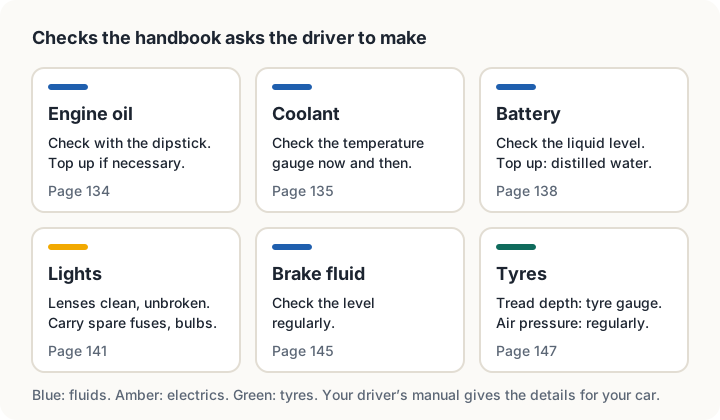
Fig. Figure 7.1Checks you can make yourself. Original illustration, based on Handbook Chapter 7, pp. 134, 135, 138, 141, 145, 147
Checks you can make yourself
Across the chapter the handbook names a handful of checks it expects the driver to make. Each one is explained in its own section below.
Engine oil: check with the dipstick and top up if necessary.
Coolant: glance at the temperature gauge every now and then.
Battery: check the liquid level and top up with distilled water if necessary. Most cars have maintenance-free batteries.
Lights: lenses clean and unbroken, with spare fuses and bulbs in the car.
Brake fluid: check the level regularly.
Tyres: check tread depth with a tyre gauge and air pressure at regular intervals.
The engine is the powerhouse of the vehicle. Oil lubricates, cools, seals and cleans it, so oil checks and oil changes matter.
Source: Handbook §7.2.1, pp. 133–134
Definition
The engine
The engine is the powerhouse of the vehicle. It is usually mounted at the front and runs on petrol, diesel or gas. Most passenger cars run on petrol. Other fuels exist, but the handbook describes most of them as still experimental and not in common use.
Source: Handbook §7.2.1, p. 133
Note
The four jobs of engine oil
Lubrication is crucial to the smooth running of the engine. The handbook gives oil four key functions.
Lubrication: a fine film of oil coats parts that rub together. It reduces friction and wear, prevents loss of energy and stops the parts seizing up.
Cooling: oil circulates to the hot parts of the engine, absorbs heat from combustion and friction, and carries it away.
Sealing: oil seals the gap between the cylinder wall and the pistons, so pressure does not escape and power is not lost.
Cleaning: oil washes away the sludge and soot that stick to the inside of the engine.
Source: Handbook §7.2.2, p. 134
Rule
Check the oil and change it on schedule
Check the oil with the dipstick and top it up if necessary. Change the oil and the oil filter as instructed in the driver’s manual.
Skipping scheduled services can prove expensive in the long run, above all for the engine. Regular oil changes are essential in the hot climate of the Middle East, even though special oils have been developed for high temperatures.
Source: Handbook §7.2.2, p. 134
Section 3 of 14
The cooling system
The cooling system keeps the engine at its correct operating temperature. Know what to do, and what not to do, when the engine overheats.
Source: Handbook §7.2.3, p. 135
Note
What the cooling system does
The cooling system cools the engine and keeps it at the correct operating temperature. The coolant is a liquid made of ethylene-glycol and water, which also helps to prevent rust inside the engine.
An engine with too little coolant can overheat quickly, so check the temperature gauge on the dashboard every now and then. An engine running at the correct temperature also saves fuel.
The electric cooling fan is protected by a fuse. If the fan fails, the engine may overheat: stop immediately and check for the fault.
A belt often drives the water pump. If the belt is loose or broken, coolant flow is poor and the engine ends up overheating.
Source: Handbook §7.2.3, p. 135
Steps
If the engine overheats
The handbook gives these steps. Take great care throughout: boiling water from the radiator can burn you badly.
1Stop the car and switch off the engine, or leave it idling, according to the condition.
2Wait until the temperature has gone down to about 90°C.
3Be extremely careful when undoing the radiator cap.
4To remedy the fault: check and adjust the drive belt, change the fuse of the electric cooling fan, or top up with hot water.
5Filling a hot radiator with cold water can easily crack the cylinder block.
Source: Handbook §7.2.3, p. 135
Note
Air conditioning and engine heat
On a hot day, switch on the "recirculated air" function of the air conditioner or climate control. The air already inside the car is then recirculated, instead of hot outside air being drawn in and cooled.
Turn the air conditioner or climate control off when driving up a steep hill. This helps to stop the engine overheating and gives some extra power for the climb.
Source: Handbook §7.2.3, p. 135
Section 4 of 14
The fuel and exhaust systems
Fuel fumes and exhaust gases are both harmful. Handle fuel carefully, and never let exhaust gas build up around you.
Source: Handbook §7.2.4, pp. 136–137
Note
Fuel injection and filling up
Modern engines have no carburettor to mix air and fuel. The fuel is sprayed directly into the cylinders by what is called the electronic fuel injection system.
When you fill up, try not to breathe in the fumes, because they can cause cancer. Wash thoroughly if you get fuel on your skin.
Lead compounds used to be added to petrol to raise its octane rating and improve engine performance.
Lead is no longer added, because exhaust emissions containing lead and other pollutants threaten human health and harm the environment in the long term.
The octane number measures a fuel’s anti-knocking performance.
Source: Handbook §7.2.4, p. 136
Note
Check against current rules
Unleaded petrol grades listed in the handbook
The 2018 handbook lists three grades of unleaded petrol sold in the UAE. It says all cars can run on "Special" 95, while some high-performance cars may require "Super" 98. The grades on sale today may differ, so follow your driver’s manual.
"E Plus": red, 91 octane.
"Special": green, 95 octane.
"Super": blue, 98 octane.
Source: Handbook §7.2.4, p. 136
Check against current rules. This point could not be fully verified or may have changed since the 2018 handbook.
Important
Exhaust gas contains carbon monoxide
Exhaust gases contain carbon monoxide, a colourless, odourless and poisonous gas, along with many other substances that harm people and the environment.
If the exhaust system is corroded or damaged, carbon monoxide and other poisonous gases may start seeping into the passenger compartment. An abnormally loud exhaust may be a sign that the silencer is damaged or cracked.
Source: Handbook §7.2.5, p. 137
Definition
The catalytic converter
The catalytic converter is an emission control device in the exhaust system. It uses a catalyst to convert the harmful compounds in the exhaust (carbon monoxide, hydrocarbons and nitrogen oxide) into harmless ones.
It deals only with toxic and polluting gases. Carbon dioxide and sulphur are still produced and emitted.
Cars with catalytic converters must be filled up only with unleaded petrol.
Source: Handbook §7.2.5, p. 137
Rule
Keeping exhaust fumes out
The handbook lists these points to remember about exhaust fumes.
Never run the engine in a garage or enclosed space for longer than absolutely necessary.
At the first sign of poisoning, provide an adequate supply of fresh air.
Driving with the boot open may cause carbon monoxide to be sucked into the passenger compartment.
At a standstill in a tailback, or crawling in heavy traffic, turn off the ventilation and open a window.
Switch off the engine if you have to wait for a long time.
Have the exhaust system checked when the car is serviced.
Source: Handbook §7.2.5, p. 137
Section 5 of 14
The electrical system
The generator charges the battery, fuses protect each component, and a flat battery can be started from another car with jump leads.
Source: Handbook §7.2.6, pp. 138–139
Note
Generator, drive belt and battery
A generator, connected to the engine by a drive belt, produces the car’s electrical power. That power is stored in the battery.
If the drive belt is incorrectly adjusted, the generator’s output drops and a warning lamp or indicator on the instrument panel lights up to warn you of the fault.
If the battery is low, it will be difficult to run the engine.
Battery acid is corrosive to skin and clothes, so handle the battery carefully.
Source: Handbook §7.2.6, p. 138
Rule
Check the fuse first
Components that use electricity are almost always fitted with a fuse, to prevent fire or damage to the electrical system. If an electrical component fails completely, the first thing to do is check its fuse.
Check the liquid level in the battery and top up with distilled water if necessary. Most cars have maintenance-free batteries.
Check that the generator drive belt is properly adjusted.
Check that the battery cables are securely connected.
Check the charging control lamp while you are driving.
Source: Handbook §7.2.6, p. 138
Steps
Starting with jump leads
If the battery is too low to start the engine, you can connect to another vehicle with jump leads. The other vehicle’s battery must be of the same voltage as yours. Connect the leads in this order.
11. One end of the red lead to the positive terminal of the other car’s battery (red, or marked P or +).
22. The other end of the red lead to the positive terminal of the discharged battery. Note where the positive terminal is.
33. One end of the black lead to the negative terminal of the other battery (black, or marked N or -).
44. The other end of the black lead to the cylinder block, or another place in contact with the negative terminal of the discharged battery.
5Why step 4 matters: sparks may otherwise detonate the hydrogen gas that forms around the battery.
Source: Handbook §7.2.6, pp. 138–139
Note
Useful to have in the car
The handbook suggests keeping a few electrical spares handy.
Fuses.
Jump leads.
A fan belt or generator drive belt.
Extra bulbs.
Source: Handbook §7.2.6, p. 139
Section 6 of 14
Vehicle lights
Lights are how drivers communicate. They must be clean, correctly adjusted and used without dazzling anyone.
Source: Handbook §7.2.7, pp. 140–141
Rule
Check against current rules
Using your headlights
Drivers communicate with each other through their lights, so yours should be clean and properly adjusted at all times. Headlights show a white beam and must be used, on full beam or dipped, during the hours of darkness. Whether on full beam or dipped, they must not dazzle drivers coming towards you or driving in front of you.
Full beam may be used in darkness, except when oncoming vehicles are approaching or when you are close behind a vehicle in your lane.
You need not dip your lights for pedestrians.
Fog lights may be used instead of dipped headlights in fog or heavy rain, or together with them.
Auxiliary headlights may only be used together with the main beam headlights, and must all switch off at the same time.
Source: Handbook §7.2.7, p. 140
Check against current rules. This point could not be fully verified or may have changed since the 2018 handbook.
Note
Check against current rules
Lights at the front of the car
The handbook lists what the front of the car must be fitted with. Equipment rules may have changed since 2018.
Full beam headlights, correctly adjusted.
Dipped headlights, adjusted to avoid dazzling other drivers. Only one pair of dipped beam headlights may be fitted.
Parking lights: two white or yellow lights that show the width of the car.
Indicators: orange-yellow, two at the front and rear and one on each side of the car.
Source: Handbook §7.2.7, p. 140
Check against current rules. This point could not be fully verified or may have changed since the 2018 handbook.
Note
Check against current rules
Lights at the rear of the car
The handbook lists what the rear of the car must be fitted with. Equipment rules may have changed since 2018.
Tail lights: two red.
Reversing lights (not always standard): one or two white.
Brake lights, also called stoplights: two (or three) red.
Registration plate lights: one or two white.
Indicators: two, orange or red.
Rear reflectors: two red.
Rear fog lights (not always standard): one or two red.
Source: Handbook §7.2.8, p. 141
Check against current rules. This point could not be fully verified or may have changed since the 2018 handbook.
Important
Rear fog lights can dazzle
Rear fog lights can sometimes dazzle the driver behind you, and they can be mistaken for stoplights. Only use them in thick fog, heavy rain or similarly difficult weather conditions.
Source: Handbook §7.2.8, p. 141
Steps
Look after your lights
A few regular checks keep your lights working and stop them dazzling others.
1Keep the lenses clean at all times.
2Check that the lenses are not broken. Scratches and chips cause dazzle and let in moisture, which corrodes the reflector.
3Check whether the lights need adjusting.
4If there seems to be an electrical fault, start by checking the fuses.
5Keep a stock of spare fuses and bulbs.
6Check that the nozzles and wipers of the headlight washers work properly.
Source: Handbook §7.2.8, p. 141
Section 7 of 14
Dashboard indicators
Warning lamps on the instrument panel let you monitor the car and protect it from damage. Your driver’s manual explains the symbols on your own car.
Source: Handbook §7.2.9, pp. 142–143
Note
What the instrument panel is for
The visual aids that show what is going on in your car are grouped on the dashboard, directly in front of the driving seat. The warning lamps help you drive safely, monitor the engine’s performance, protect the engine and other equipment against damage, and see that everything is working as it should.
Symbols differ between cars. For the symbols on your car and their meaning, see your driver’s manual. Keep a regular eye on the dashboard while you drive.
Source: Handbook §7.2.9, pp. 142, 146
Note
Warning lamps: brakes, engine and fuel
The handbook lists twelve lamps that may be fitted. These are the first six.
Brake warning lights: brake condition, brake pad wear or low brake fluid level.
Oil pressure, often red: the oil is dangerously low or is not circulating as it should. It lights up red when you turn the ignition on and goes out as the engine starts.
Ignition warning light, usually red: if it comes on while the engine is running, there is a problem with the electrical charging system.
Temperature gauge, sometimes a warning light: it measures the water temperature and can tell you if the engine is overheating.
Fuel gauge: you are running on a low fuel level.
High-beam indicator light, usually blue.
Source: Handbook §7.2.9, p. 143
Note
Warning lamps: parking brake, ABS, airbags and more
These are the remaining six lamps on the handbook’s list.
Parking brake ON warning light.
Rear fog lamps indicator or warning light.
ABS warning light: the anti-lock brake system is not functioning.
Airbag or SRS (Supplemental Restraint System) warning light: the airbag system is not functioning.
Fluid low, for the windshield wiper.
Seat belt warning lights.
Source: Handbook §7.2.9, p. 143
Section 8 of 14
The transmission system
The clutch and gearbox carry the engine’s power to the drive wheels.
Source: Handbook §7.2.10, p. 144
Definition
Clutch and drive wheels
The engine’s power is transmitted through the clutch to the drive wheels. These may be the rear wheels, the front wheels, or both in a four-wheel drive vehicle, which can be a real help on a poor road or off-road.
The clutch sits between the engine and the gearbox. When you press the clutch pedal, the engine is disconnected from the transmission system, and no power reaches the drive wheels until the clutch is re-engaged.
Source: Handbook §7.2.10, p. 144
Note
Manual and automatic gearboxes
A manual gearbox may have five or more gears, each used for a specific speed range. Get used to the sound of your engine: it tells you when it is time to change gear, and you can both hear and feel when you are in the right one.
Automatic gearboxes are increasingly common. They have no clutch pedal, and the gear shift happens automatically when the vehicle reaches a certain speed.
Source: Handbook §7.2.10, p. 144
Section 9 of 14
The brake systems
Two independent brake systems, a dual-circuit main brake, a servo that needs the engine running, and ABS to keep steering control.
Source: Handbook §7.2.11, pp. 145–146
Definition
Two independent brake systems
All cars have two independent brake systems. The main brake acts on all four wheels and is hydraulically operated. The parking brake, or handbrake, is mechanically operated.
The main brake is a dual-circuit type: two or three of the four wheels can still be braked even if one of the two circuits fails completely. A circuit may, for example, include both front wheels and one rear wheel.
If the main brake fails completely, do not try to drive the vehicle. Call for a breakdown truck.
Source: Handbook §7.2.11, p. 145
Rule
Brake fluid: what a falling level means
In a hydraulic system, pressure from a special incompressible brake fluid presses friction material against the rotating parts, and the friction slows and stops the wheels. Check the brake fluid level regularly.
Brake fluid is not consumed in normal use, so a change in level tells you something.
A drop of several centimetres signals a leak.
A small drop, of a few millimetres to one centimetre, is a sign that the brake pads are wearing and probably need attention.
Never attempt to use engine oil instead of brake fluid.
Source: Handbook §7.2.11, pp. 145–146
Important
The brake servo only works with the engine running
Cars have a servo-controlled braking system, or booster. It uses a vacuum from the engine to multiply the force your foot applies to the brake pedal, so less pedal force is needed.
The servo works only while the engine is running. With the engine switched off, braking is very difficult indeed, so take extreme care if you ever need to be towed.
Source: Handbook §7.2.11, pp. 145–146
Definition
ABS: anti-lock braking system
ABS prevents the wheels from locking. It helps preserve directional stability and steering control even if you have to slam on the brakes in an emergency, so you can brake hard and still have some chance of steering out of trouble.
A yellow light on the dashboard comes on if the ABS system breaks down.
Source: Handbook §7.2.11, p. 146
Definition
Drum brakes and disc brakes
A drum brake uses friction from a set of shoes that press against a rotating drum-shaped component. In a disc brake, the friction between the pads and the disc does the braking. Rear drum brakes are often combined with disc brakes at the front.
Source: Handbook §7.2.11, p. 146
Steps
Test your brakes before setting off
Before setting off, make sure the brakes act equally on all four wheels. Unbalanced brakes may send you into a skid if you have to brake hard. If you borrow a car, it is wise to try the brakes before you set off. Before test braking, make sure nobody is on the road behind you.
Test braking has three main purposes.
1To check that the brakes are functioning correctly.
2To check the stopping distance of the car and the friction of the road surface.
3To check that the brakes pull evenly.
Source: Handbook §7.2.11, p. 146
Section 10 of 14
The tyres
Tyres give the car control, grip and safety. Watch their age, tread and air pressure, and fit the type the car was designed for.
Source: Handbook §7.2.12, pp. 147–148
Rule
Age matters more than mileage
In this region’s extreme heat you may need to change tyres more often, because of friction from high speed, humidity, heat and other factors. The handbook calls age the most important issue in changing tyres.
A car that covers around 50,000 km in a year may need new tyres after 12 months.
A car that has not done 14,000 km in three years still needs new tyres, because the carcass of the tyre has aged.
Each tyre has a date code embossed on its sidewall. It begins with the week, and the last part is the year: 00 for a tyre made in 2000, 02 for one made in 2002.
Source: Handbook §7.2.12, p. 147
Rule
Tread depth and tread wear indicators
Tyres carry several sets of TWI markings, or tread wear indicators. When this raised rubber is level with the rest of the tread, the tyres are balding and need changing.
The main tread of a new tyre is about 9 mm deep. By the time it has worn down to about 3 mm, the tyre has started to lose its grip, and the risk of aquaplaning, where the car skates out of control on a sheet of water, increases steeply. Check the tread depth with a tyre gauge.
Source: Handbook §7.2.12, p. 147
Rule
Check air pressure regularly
Make a habit of checking tyre pressure at regular intervals. It should be at least the pressure recommended by the car’s manufacturer; the handbook describes the figure in the driver’s manual as only the recommended minimum. Neglecting air pressure costs money and impairs performance.
Under-inflation, even slight, increases fuel consumption, makes the car harder to handle and shortens the life of the tyre.
Slight over-inflation does not damage the tyre. The handbook says it can lengthen tyre life and even improve fuel consumption.
Steel radial tyres are more sensitive to under-inflation than to over-inflation.
Source: Handbook §7.2.12, pp. 147–148
Note
Types of tyre
The handbook describes several kinds of tyre and what each is suited to.
Steel radial tyres: the most commonly used today. An internal layer of metal bracing makes them more resistant to wear and gives far better road grip.
Regular tyres: a synthetic rubber compound with a finely patterned tread, for a smooth, comfortable ride in dry and wet weather.
Off-road tyres: a generous, coarsely patterned tread. Not suitable for regular driving.
Re-treaded tyres or remoulds: not a recommended choice, because heat builds up in the rubber.
Emergency (spare) wheel: its maximum recommended speed is in the driver’s manual. Be prepared for the car to handle in unexpected ways.
Source: Handbook §7.2.13, p. 148
Rule
Fit the tyres your car came with
For the best safety, grip, control and braking power, keep to the tread pattern, size and type of tyre that originally came with the car, on all four wheels. When changing tyres it is best to change at least a pair at a time, so that each pair of wheels has identical tyres.
Do not try to save money with cheap tyres, which can involve tremendous risk. Stay with standard brands and tyres suited to your car.
Source: Handbook §7.2.13, p. 148
Note
Getting the most from your tyres
Three things decide how long a set of tyres lasts.
Wheel alignment: wrong alignment is the main cause of excess wear and tear. Have it checked routinely.
Wheel balancing: if the tyres are not balanced, the car wobbles and the tyres wear faster.
Speed: the faster you drive, the hotter the tyre gets. Tyres wear twice as fast at 120 km/h as at 80 km/h.
Source: Handbook §7.2.13, p. 148
Section 11 of 14
The steering systems
Power steering makes the wheel easy to turn, but only while it works. Heavy steering or a car that pulls to one side needs attention.
Source: Handbook §7.2.14, p. 149
Definition
Manual and power steering
The steering system is made up of the steering wheel, gears, linkages and other parts that control the direction of the vehicle. There are two basic types.
With manual steering the driver turns the wheels using only his or her own strength. Power steering uses energy from the engine to amplify the force applied to the steering wheel. Turning is much easier, and the driver has more time to react in an emergency.
Power steering uses a special high-pressure fluid, automatic transmission oil. Never use ordinary engine oil instead.
Source: Handbook §7.2.14, p. 149
Important
Never drive with defective power steering
Never attempt to drive a car with defective power steering. The wheel can still be turned, but the steering is so heavy that taking the car out on the road would be highly dangerous. Bear this in mind if you ever need to be towed.
Source: Handbook §7.2.14, p. 149
Note
Reading steering symptoms
The way the steering feels points to the likely fault.
Steering pulls or snatches when you turn the wheel: air or dirt has probably got into the servo system.
Car tends to pull off to the right or left: the wheels may need aligning, or one front tyre may have too little air.
Steering unusually heavy, or the car drifts to one side on a straight, level road: there may be a fault in the steering gear, or a front tyre may need more air.
Source: Handbook §7.2.14, p. 149
Note
How wheels go out of alignment
Driving against the kerb or into an obstacle may force the front wheels out of alignment or cause unnecessary wear on the steering system. Careless driving on bad roads, or off-road driving, can also damage the steering gear.
Faulty alignment makes the car pull to one side and the tyres wear unevenly.
Poorly aligned wheels also cause vibrations. The extra wear on tyres and steering can lead to play, or looseness, in the steering system.
Source: Handbook §7.2.14, p. 149
Section 12 of 14
Economical driving
Sensible driving habits and a properly maintained car save fuel, money and the environment.
Source: Handbook §7.3, p. 150
Steps
Habits that save fuel
Economical driving saves energy, the environment and money. It starts with a well-kept car and a smooth driving style.
1Have the car serviced at regular intervals.
2Keep the tyres at the correct pressure, as given in the driver’s manual.
3Do not idle the engine.
4Use the car’s own speed: take your foot off the accelerator.
5Do not use the brakes unnecessarily.
6Drive to match the rhythm of the traffic around you. In busy traffic, overtaking saves little time but increases fuel consumption and the risk of an accident.
7Before a traffic light, or when the car ahead is going to turn, brake by using the engine, that is, by decelerating, so that you can keep moving without stopping unnecessarily.
Source: Handbook §7.3, p. 150
Note
Gears, throttle and engine speed
The throttle is the device that controls the flow of fuel or power to the engine. The handbook’s advice on gears is aimed at keeping engine speed (rpm) from running too high.
When starting off, change to second gear as quickly as possible, then to higher gears at one-third to half throttle.
Accelerate in each gear until engine torque is at its highest, normally at around 3,000 rpm.
While accelerating you may sometimes skip a gear.
With a powerful, high-torque engine it is better to accelerate a little more than to change down.
Keep the throttle at a uniform level. A suitable engine speed is around 2,000 rpm; use fifth gear whenever possible, depending on the road.
Source: Handbook §7.3, p. 150
Section 13 of 14
Heavy loads and trailers
A loaded car corners, accelerates and brakes differently. Secure the load, keep your view clear and check the trailer before you leave.
Source: Handbook §7.4, p. 151
Steps
Before setting out with a caravan or trailer
Your driver’s manual gives the permitted trailer loads, the maximum safe load for your vehicle and how that load should be distributed. Before setting out, make sure of the following.
1The caravan or trailer is properly loaded and correctly hitched.
2The emergency wire is properly connected.
3The lights and electric brake are properly connected.
4All lights work, and all lamps, reflectors and plates are clean.
5The supporting leg and wheels are securely screwed in position.
Source: Handbook §7.4, p. 151
Rule
Passengers and load must not get in the driver’s way
Never carry more passengers than allowed. Neither load nor passengers may obstruct the driver’s view of the road, or prevent the driver from having control of the vehicle at all times.
A child should never sit on the lap of an adult in a moving car.
Source: Handbook §7.4, p. 151
Important
Roof loads raise the risk of rolling over
Any load on the roof sits above the vehicle’s centre of gravity and increases the likelihood of the vehicle rolling over. The permitted roof load is in your driver’s manual.
Check that the roof rack is securely fastened, and that braking, accelerating or cornering will not displace the load.
Place the load against the front edge of the rack and secure it so that it cannot roll, slip or fall.
If you use a tarpaulin, remember the effect of wind.
Distribute the load evenly and do not overload the rear.
Check the tyres and the adjustment of the lights, and check the load frequently.
Source: Handbook §7.4, p. 151
Note
How a heavy load changes the car
A heavy load or incorrect tyre pressure affects the car’s performance, particularly its cornering, its acceleration and its braking distance.
Overtaking takes longer, because the engine has a heavier load to pull.
Braking distance increases downhill, because the weight of the load pushes the car forward.
If you are involved in any way in an accident with a vehicle displaying a hazard warning for dangerous goods, extreme caution is imperative.
Source: Handbook §7.4, p. 151
Section 14 of 14
Vehicle inspection, registration and insurance
What the 2018 handbook says about Vehicle Inspection Centres, number plates and third party insurance. Check current requirements with the authorities.
Source: Handbook §7.5, pp. 152–153
Note
Check against current rules
Vehicle Inspection Centres (VICs)
According to the handbook, Vehicle Inspection Centres exist to inspect all registered motor vehicles. If a car fails the VIC tests, all faults must be repaired without delay. Until then it is not considered roadworthy and should not be driven, and driving it may bring a hefty fine.
The handbook does not say how often a vehicle must be inspected. Check the current requirement.
VICs set technical specifications and safety standards.
They allow well-maintained vehicles on the roads and see that dangerous ones are taken off public highways.
They work to bring down carbon monoxide and other gas emissions.
They manage the collection of fines from owners in breach of the regulations.
Source: Handbook §7.5, p. 152
Check against current rules. This point could not be fully verified or may have changed since the 2018 handbook.
Note
Check against current rules
Number plates and registration certificate
The handbook says VICs provide number plates and a registration certificate. All vehicles must display a pair of number plates, kept legible and clearly visible, and the registration certificate must be carried in trucks, buses, cars and off-road vehicles.
Abroad, depending on the country, you may be asked for an International Driving License, which the handbook describes as essentially a translation of your UAE licence, issued by automobile clubs operating in the UAE.
Source: Handbook §7.5, p. 152
Check against current rules. This point could not be fully verified or may have changed since the 2018 handbook.
Note
Check against current rules
Third party insurance
The handbook states that third party insurance is compulsory. It covers injuries and damage to third parties caused by, or arising from, the use of a motor vehicle on the road: bodily injury and damage to other people’s property.
It does not cover damage to your own vehicle or any load you are carrying, so the handbook calls it wise to take out some form of extra insurance.
By law, the owner or driver of the car responsible for an accident is liable for the cost of repairs and other related costs.
Never drive a car without a valid vehicle licence: the handbook says it is illegal and you will not be covered by the third party policy.
Source: Handbook §7.6, p. 153
Check against current rules. This point could not be fully verified or may have changed since the 2018 handbook.
Note
Check against current rules
Arranging insurance, and after an accident
Premiums vary considerably between insurers. Get advice when arranging a policy and read the terms carefully before signing.
The handbook also advises never accepting the blame for an accident directly on the spot, because anything said while in shock or confusion may be noted and used against you later.
The premium depends on the traffic and accident categories of your type of vehicle, theft statistics for the make and model, annual mileage, where you live and any no-claims bonus or discount.
As a rule, sports cars cost more to insure than ordinary models, so ask insurers about their policies before choosing a car.
Source: Handbook §7.6, p. 153
Check against current rules. This point could not be fully verified or may have changed since the 2018 handbook.
Chapter 7 recap
Remember this
Engine oil has four jobs: lubricating, cooling, sealing and cleaning.
Overheating engine: stop, let it cool to about 90°C, take great care with the radiator cap, and never pour cold water into a hot radiator.
Carbon monoxide is colourless, odourless and poisonous. In a tailback, turn off the ventilation and open a window.
An electrical component has failed completely: check the fuse first.
The brake servo works only with the engine running, so braking is very difficult when being towed.
ABS stops the wheels locking and helps you keep steering control when braking hard.
Brake fluid is not used up: a drop of several centimetres signals a leak.
Tread wear indicators level with the tread mean the tyres are balding and need changing.
Under-inflated tyres use more fuel, handle worse and wear out sooner.
Common misconceptions
Myth
: Tyres with plenty of tread and low mileage never need replacing.
Fact
: Age is the most important factor. A car that has not covered 14,000 km in three years still needs new tyres, because the carcass of the tyre has aged.
Source: Handbook §7.2.12, p. 147
Myth
: Running tyres a little soft does no harm.
Fact
: Air pressure even slightly below the recommended level increases fuel consumption, makes the car more difficult to handle and shortens the life of the tyre.
Source: Handbook §7.2.12, p. 147
Myth
: A catalytic converter makes exhaust gas harmless.
Fact
: The converter deals only with toxic and polluting gases. Carbon dioxide and sulphur are still produced and emitted, and a corroded or damaged exhaust can still leak carbon monoxide into the car.
Source: Handbook §7.2.5, p. 137
Myth
: When the engine overheats, pour cold water into the radiator straight away.
Fact
: Filling a hot radiator with cold water can easily crack the cylinder block, and boiling water can burn you badly when the cap is undone. Wait for the temperature to fall to about 90°C.
Source: Handbook §7.2.3, p. 135
Myth
: A car being towed brakes and steers just as it normally does.
Fact
: The brake servo works only when the engine is running, so with the engine off braking is very difficult indeed. Defective power steering is likewise extremely heavy.
Source: Handbook §7.2.11, pp. 146, 149
Chapter 7 · practice
Check your knowledge
6 quick questions on this chapter, with an explanation after each answer. Or practise all 13 questions written for it.