Gulf weather is usually fine and hot, but heat, glare, darkness, fog, wind and rain each change how a car behaves and how much you can see. This chapter covers preparing the car, coping with summer heat, driving and using your headlights at night, and what to do in fog, high winds, rain, floods, aquaplaning and skids.
About 25 minutes
11 sections
Handbook Chapter 4, pp. 74–86
Chapter 4 · 11 sections
After this chapter you can
Prepare tyres, windscreen and wipers before driving in hot weather.
Explain why night driving is riskier and choose a speed that matches the range of your lights.
Use full beam, dipped headlights and parking lights correctly at night.
Choose the right lights, speed and following distance in fog.
Describe the hazards of high winds, blown sand, light rain and heavy rain.
Recognise aquaplaning and respond to it correctly.
Drive through shallow flood water safely and recover from a skid.
Section 1 of 11
Hot weather: your vehicle
Check tyre pressure while the tyres are cold, and keep the windscreen and wipers in good order.
Source: Handbook §4.1.1, p. 74
Rule
Check tyre pressure when the tyres are cold
Check and adjust your tyre pressures before you start the journey, while the tyres are still cold. After you have been driving for a while the tyres are warm, and the reading will be inaccurate.
Source: Handbook §4.1.1, p. 74
Note
A clean windscreen cuts glare
Keep the windscreen as clear as possible of water and grease marks, because this helps to reduce glare. Your vision is seriously impaired if the wipers are worn out or the glass is coated with a film of traffic dirt from exhaust gases and other pollutants.
Check the windscreen washer reservoir and top it up if necessary. An additive may help keep the glass clean.
Smoking leaves a thin film on the inside of the windows that reduces visibility. Do not smoke while driving.
Source: Handbook §4.1.1, p. 74
Section 2 of 11
Extreme summer weather: heat and sunshine
Glare and heat tire you out. Rest in a safe place, never on the motorway hard shoulder, and expect slippery roads when rain follows a dry spell.
Source: Handbook §4.1.2, p. 75
Note
Sun in your eyes
Constant sun in your eyes is exhausting on a long journey and can affect your concentration. The correct sunglasses reduce the glare and keep your eyes working well for longer, even if you do not feel you need them. Avoid looking directly into the sun.
Source: Handbook §4.1.2, p. 75
Rule
Feeling sleepy: stop somewhere safe
Take plenty of breaks and refreshment on a long trip. If you feel sleepy, stop and rest where it is safe to do so.
Never stop on the hard shoulder of a motorway when you feel tired. Use the service areas, or leave the motorway.
Source: Handbook §4.1.2, p. 75
Important
Oil, water and a hot road
Oil and water can make the hot road surface slippery and dangerous, particularly when a sudden rain shower follows a long dry spell. Take extra care: watch your speed and keep your distance.
Source: Handbook §4.1.2, p. 75
Note
After a large midday meal
Hot summer temperatures lower your energy, especially after a large midday meal, when drowsiness may set in. Before a long journey, take time to digest the meal or, if possible, sleep it off.
If that is not practical, remember that your normal senses could be affected. Drive slower than normal and take extra care.
Source: Handbook §4.1.3, p. 75
Section 3 of 11
Driving in the dark: eyes and speed
You see less at night and misjudge speed and distance more easily, so you must be able to stop within the range of your lights.
Source: Handbook §4.2, p. 76
Note
Check against current rules
Why night driving is riskier
The handbook says the risk of an accident is greater at night than in daylight, and that many fatal accidents happen in the dark. The main reason it gives is that our eyes are not designed for night vision: you cannot see as far, so less information is available to you.
It also quotes two figures: over 600 people killed on UAE roads each year, and a risk up to six times greater at a speed of 120 km/h. These are 2018 handbook figures and may be out of date.
Source: Handbook §4.2, p. 76
Check against current rules. This point could not be fully verified or may have changed since the 2018 handbook.
Note
Your eyes at night
Judging distance depends on seeing shapes and colours clearly. In darkness, fog, mist or rain, oncoming traffic appears to be further away than it actually is, which can lead to errors of judgment when you pass another vehicle.
Give your eyes a minute or two to adjust to the dark, particularly when you come out of a brightly lit area or building.
Have your eyesight checked regularly. Poor vision at night may be a sign that you need an eye test.
Do not spray or tint the windscreen or windows with tinted colour.
Source: Handbook §4.2.1, p. 76
Rule
Stop within the range of your lights
At night, your own speed and distance and those of other motorists are easy to misjudge. You cannot safely drive as fast at night as in daylight, and that includes dusk and dawn, even in good weather.
Never drive so fast that you cannot stop well within the clear distance you can see ahead, which means within the range of your lights. If you cannot stop safely within that range, you are going too fast.
Source: Handbook §4.2.2, p. 76
Section 4 of 11
Using your lights and headlights
Lights let you see and be seen. Dip for oncoming vehicles and vehicles you catch up, and go back to full beam as soon as you can do so without dazzling anyone.
Source: Handbook §4.2.3, pp. 76–78
Note
See and be seen
At night your lights are the most important source of information for you and for other drivers. With your lights on, others can see you earlier and tell which way you are heading.
You may find it best to switch on before dusk. Do not be afraid to be the first driver to put lights on: it is better to see and to be seen. At dawn, do not switch your lights off until you are sure it is safe.
Source: Handbook §4.2.3, p. 76
Rule
Oncoming vehicle: dip your headlights
When you see an oncoming vehicle at night you must dip your headlights so that you do not dazzle the other driver. This applies to all types of vehicle, including bicycles. You do not need to dip for pedestrians.
Keep your eyes to the right-hand side of the road and look as far ahead as you can.
On full beam, check the right-hand verge before you dip. Do not dip too soon.
Switch back to full beam as soon as you start to pass the other vehicle. On dipped lights, pedestrians walking on the right are often hard to see.
Visibility is severely restricted, so drive at an appropriately low speed.
A bus or lorry coming over the brow of a hill: dip as soon as you see its marker lights.
Source: Handbook §4.2.4, p. 77
Rule
Catching up and overtaking at night
When you catch up with another vehicle you must dip your headlights so that you do not dazzle the driver in the rear-view mirror. Buses and lorries have large mirrors, so dip early when you see one ahead.
When you overtake, switch back to full beam as soon as you are sure you will not dazzle the other driver in the mirror. Overtaking at night is harder because you see less: only overtake if you can see that the road ahead will stay clear until you have finished.
Source: Handbook §4.2.5, p. 77
Rule
Being overtaken, and bends
Your headlights can help or hurt other drivers depending on where they point.
Being overtaken: keep full beam on for as long as possible, or until the other car becomes just visible to your left. Your lights light the road for both of you.
Approaching a right-hand bend: dip earlier, because your headlights cut straight across the eyes of anyone coming towards you.
Approaching a sharp left-hand bend: you may not need to dip at all.
Source: Handbook §4.2.6, p. 78
Section 5 of 11
Night positioning, stopping and built-up areas
Where to place the car in the dark, which lights to show when stopped, and how to drive in lit streets.
Source: Handbook §4.2.8, pp. 78–79
Rule
Positioning in the dark
At night it is safer to drive closer to the centre line than you would during the day. When you meet an oncoming vehicle, keep halfway between the centre line and the edge line, and do not drive on the hard shoulder.
A pedestrian in dark clothing may be walking near the verge and will be hard to see. Remember too that drivers coming the other way may not see as well as you can.
Source: Handbook §4.2.8, p. 78
Rule
Stopping at night: headlights off, parking lights on
Always switch off your headlights when you stop, even for a short while, and switch on your parking lights instead. The fixed glare of headlights can be very dazzling, especially if the vehicle is facing oncoming traffic.
For an emergency stop in the dark, you must set up your advance warning triangles at some distance behind the car and, if the electrical system still works, switch on your hazard lights.
Source: Handbook §4.2.9, p. 78
Important
Check against current rules
Headlights left on while parked
The handbook states that it is an offence to leave your headlights on when the vehicle is parked. This is a legal statement from the October 2018 edition, so check the current rule with your instructor.
Source: Handbook §4.2.9, p. 78
Check against current rules. This point could not be fully verified or may have changed since the 2018 handbook.
Rule
Built-up areas: dipped headlights
Always use dipped headlights in built-up areas at night, because it helps others to see you. In built-up areas with adequate street lighting, driving on full beam is prohibited.
Where streetlights leave patches of shadow, watch for pedestrians who can be difficult to see.
Source: Handbook §4.2.10, p. 79
Important
Pedestrians think they can be seen
Wherever streets are lit, expect pedestrians, cyclists, children and other unprotected road users. They are particularly vulnerable at night because they believe the streetlights make them perfectly visible, and behave much as they would in daylight.
Approach pedestrian crossings at a speed from which you can stop safely if necessary.
Source: Handbook §4.2.11, p. 79
Note
Keep noise down at night
Keep all noise to a minimum, because neighbours and children may be asleep.
Do not rev your engine.
Close your car doors quietly.
Take extra care when setting and disarming the anti-theft alarm.
Source: Handbook §4.2.12, p. 79
Section 6 of 11
Driving in fog
Dipped headlights, a low speed and a long gap. Fog hides distance and speed and leads to nose-to-tail pile-ups.
Source: Handbook §4.3, p. 80
Rule
Lights and distance in fog
When driving in fog, use dipped headlights and keep well back from the vehicle in front.
If your car has high-intensity rear fog lights, use them only when visibility is seriously reduced. They shine brightly to the rear, so following drivers see you sooner and can keep further back, which reduces the chance of a rear-end collision. You must switch them off when visibility improves, because at other times they can dazzle the drivers behind.
Source: Handbook §4.3, p. 80
Important
Why fog is dangerous
Early-morning fog can be frequent on major highways. It leads to the kind of accident where many vehicles crash into one another, nose to tail. Poor visibility strains your eyes and badly hampers your ability to anticipate: distances and speeds are much harder to judge.
Source: Handbook §4.3, p. 80
Steps
How to drive in fog
The handbook lists these habits for foggy conditions.
1Know your local weather: anticipate where and when fog usually gathers on your routes.
2Do not drift. There is a natural tendency to wander into the middle of the road, so stay in your lane.
3Use the right edge of the road as a guide. It helps you avoid oncoming traffic and being blinded by its headlights.
4Ask your passengers to help watch for oncoming cars and obstacles.
5Slow down and leave plenty of room to stop. You may not notice the vehicle ahead braking as soon as you would in clear weather.
6Avoid overtaking: visibility ahead may be much worse than you thought.
7Watch for animals, which are much harder to see in fog.
Source: Handbook §4.3, p. 80
Rule
Breaking down or parking in fog
If you break down, get your vehicle off the road if you possibly can. Inform the police, and arrange to have the vehicle removed as soon as possible if it is causing an obstruction. Never leave it on the wrong side of the road, or without hazard lights and advance warning triangles.
Never park on a road in fog if you can avoid it: find an off-street parking place. If parking on the road is unavoidable, always leave your parking lights or sidelights on.
Source: Handbook §4.3, p. 80
Illustrated
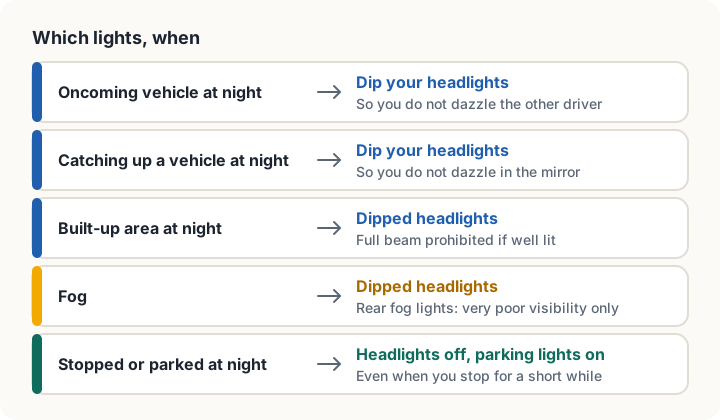
Fig. Figure 4.1Recap: which lights, when. Original illustration, based on Handbook Chapter 4, pp. 77–80
Recap: which lights, when
A summary of the lighting rules from the night-driving and fog sections.
Oncoming vehicle at night: dip, so you do not dazzle the other driver.
Catching up with a vehicle at night: dip, so you do not dazzle the driver in the mirror.
Built-up area at night: dipped headlights. Full beam is prohibited where street lighting is adequate.
Fog: dipped headlights. Rear fog lights only when visibility is seriously reduced.
Stopped or parked at night: headlights off, parking lights on.
Source: Handbook Chapter 4, pp. 77–80
Section 7 of 11
Driving in high winds
Crosswinds push vehicles off line, can topple high-sided ones, and blow sand across the road.
Source: Handbook §4.4, p. 81
Important
What a crosswind does
Some vehicles become unstable in strong crosswinds because they have a large surface and comparatively low weight. It happens particularly on exposed stretches of motorway.
The effect ranges from a simple pull on the steering wheel to a strong pull on the whole car, making it wander, perhaps into the path of another vehicle. In very bad cases the whole vehicle can be lifted off the road.
Source: Handbook §4.4, p. 81
Rule
Two-wheelers and large vehicles in wind
In gusty conditions, watch for cyclists and motorcyclists being blown sideways into your path, and allow extra room if you overtake them.
Do not stay alongside large vans and trucks, or too close to them, for longer than is absolutely necessary to overtake. There is always a chance, however small, that a strong gust could topple a large transporter onto your vehicle.
Source: Handbook §4.4, p. 81
Rule
Blown sand and the shamal
High winds also blow sand from the desert, which obscures visibility. In a strong shamal it is sensible to pull over and stop at the side of the road until the storm has passed and visibility is clear again.
When you drive off, be aware that drifting sand may have left sand spits on the road.
Source: Handbook §4.4, p. 81
Section 8 of 11
Driving in rain
Light rain turns dirty roads into skid pans; heavy rain washes them but wrecks visibility. Slow down, keep back, and never drive with hazard lights on.
Source: Handbook §4.5.1, p. 82
Important
Light rain: very slippery roads
Rain is uncommon in the Gulf, which is why it is dangerous when it comes. Vehicles drop tyre rubber, oil and grease onto the road, and this builds up into a sludge. Light rain turns that dirty surface into a "skid pan" that offers your tyres little grip.
The less grip your tyres have, the greater the distance you need to stop. Drive slower than normal and keep further back from the vehicles in front.
Source: Handbook §4.5.1, p. 82
Note
Heavy rain: poor visibility
A heavy rainstorm tends to wash the slippery film off the road, which is a good result. The problem is visibility: spray from vehicles in front can blind you even with the wipers at top speed.
At first that spray contains oil and grease washed off the road, which smears the windscreen. Washer fluid helps to dissolve the smears.
Source: Handbook §4.5.1, p. 82
Rule
No hazard lights while driving in heavy rain
Some drivers use their hazard lights in heavy rain as an excuse for high-speed driving. The handbook is clear: hazard lights must not be used while driving in heavy rain.
Source: Handbook §4.5.1, p. 82
Section 9 of 11
Aquaplaning
When a tyre cannot clear the water, the car rides on a layer of water and cannot be steered or braked. Ease off the accelerator.
Source: Handbook §4.5.2, p. 83Printed under the heading "4.5.2 Dealing with floods", although the text is about aquaplaning.
Illustrated
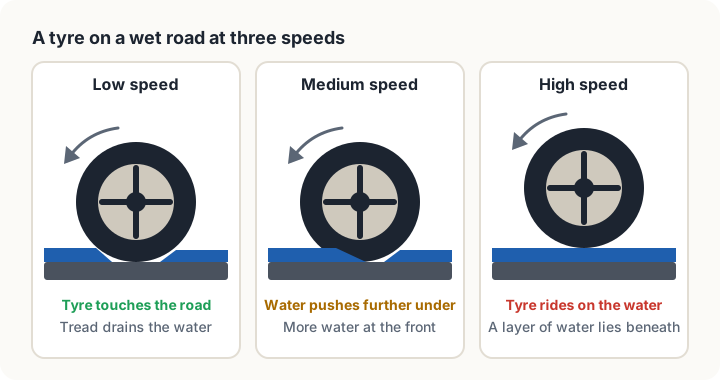
Fig. Figure 4.2What aquaplaning is. Original illustration, based on Handbook §4.5.2, p. 83
What aquaplaning is
The patch of tyre touching the road is no larger than the palm of your hand, so the tread pattern has to drain away enough water for the tyre to keep its grip.
A tyre that cannot drain the water causes aquaplaning (also called hydroplaning): the car skids along the surface of a layer of water and becomes impossible to steer or brake.
Other causes: high speed, worn treads and overly broad tyres.
The more water on the road, the greater the risk.
Even with good tyres, aquaplaning can occur at high speed.
Source: Handbook §4.5.2, p. 83
Steps
If the steering suddenly feels light
A clear sign that you are aquaplaning is that the steering suddenly feels very light.
1Slow down by easing off the accelerator.
2Never brake or try to change direction: while aquaplaning you have no control at all over steering or braking.
3To prevent it: on a wet road, slow down, keep your distance and check the road for wet surfaces.
Source: Handbook §4.5.2, p. 83
Note
Deeper water on one side
At lower speeds, if the front and rear tyres on one side hit a patch of deeper water, the vehicle may swerve because of the extra resistance on that side.
The handbook adds that at 80 km/h in rain the tyres have to force away up to 25 litres of water per second.
Source: Handbook §4.5.2, p. 83
Section 10 of 11
Dealing with flooded areas
Stop and judge the depth first. If it is shallow, cross slowly in first gear at a steady speed, then test your brakes.
Source: Handbook §4.5.3, p. 84
Steps
Passing through a flood
Take your time. Do not just drive into the water.
1Stop and assess how deep the water is.
2If it seems too deep for your vehicle, turn back and go around by another road. That is better than being stranded.
3If it is shallow and you decide to go on, drive as slowly as possible in first gear, but keep up a steady speed.
4Keep to the shallowest part. Because of the incline of the road, water is probably deepest near the edge and shallowest at the crown, or centre.
Source: Handbook §4.5.3, p. 84
Rule
Test your brakes afterwards
Once you are safely through, test your brakes. If they do not work properly, apply light pressure to the brake pedal while driving along slowly; this helps to dry them out. Do not drive at normal speed until you are sure the brakes are working normally.
Source: Handbook §4.5.3, p. 84
Note
Position for the unexpected
Always try to position the car so that you could cope with unexpected overtaking and sudden meetings with oncoming traffic in maximum safety. Overtaking and meeting oncoming vehicles always carry some risk, and the risk is even greater when your view is blocked by a hill or bend, or at night, in fog or in rain.
Source: Handbook §4.5.3, p. 84
Section 11 of 11
How to deal with a skid
Skids are caused mainly by the driver: braking too hard, accelerating too quickly or steering too sharply. To recover, come off the pedals.
Source: Handbook §4.5.4, pp. 84–85
Definition
What a skid is, and what causes it
A skid occurs when the front or rear of a moving vehicle suddenly and uncontrollably swings around in a circular movement. Depending on its force, the vehicle may stop quickly or keep turning.
Three factors cause a skid. In order of importance they are the driver, the vehicle and the road conditions. Skids do not just happen.
The brakes are applied too hard.
The vehicle accelerates too quickly.
The steering wheel is turned too sharply.
Source: Handbook §4.5.4, p. 84
Note
Skids caused by braking
Harsh, uncontrolled braking is one of the chief causes of skidding. Braking throws the weight of the car forward: the harder you brake, the more weight goes to the front wheels and the less to the rear, and the less weight on the rear wheels, the more likely they are to lock.
This can happen even on a dry road with good tyres if you suddenly brake harshly.
Brakes have their greatest stopping power when they are nearly, but not quite, locked.
Anti-lock brakes (ABS) help you keep steering while braking, but are less effective on wet or slippery roads.
Brakes are only as good as the grip of the tyres on the road.
Source: Handbook §4.5.4, p. 85
Note
Skids caused by steering and acceleration
The cure for all of these is the same: adjust your speed to the conditions and give yourself plenty of space.
Steering: skids come from steering too sharply for your speed. If you need to make a sharp turn, slow down gradually first.
Braking and steering together: you are bound to skid if your tyres are only just gripping in a corner and you start to brake.
Acceleration: sudden or harsh acceleration into a corner, particularly in the lower gears, can spin the driving wheels. Ease off the accelerator very quickly or the wheel-spin may become a skid.
Source: Handbook §4.5.4, p. 85
Steps
If you are in a skid
Drivers often instinctively keep the right foot hard down on the brake throughout a skid. That makes matters worse.
1Release the brake pedal fully, and keep off the brakes.
2Release the accelerator, and do not try to steer until the wheels regain some of their grip.
3Allow the steering wheel to settle into the same direction as the skid, easing off the accelerator at the same time.
4Be careful not to oversteer: too much movement of the front wheels leads to another skid in the opposite direction.
Source: Handbook §4.5.4, p. 85
Chapter 4 recap
Remember this
Check tyre pressures before the journey, when the tyres are cold.
Tired on the motorway: use a service area or leave the motorway, never the hard shoulder.
At night, drive at a speed from which you can stop within the range of your lights.
Dip for oncoming vehicles and for vehicles you catch up; you need not dip for pedestrians.
Stopped at night: headlights off, parking lights on.
Fog: dipped headlights, keep well back, rear fog lights only when visibility is seriously reduced.
Hazard lights must not be used while driving in heavy rain.
Aquaplaning: steering goes light. Ease off the accelerator; do not brake or steer.
In a skid: release the brake fully, release the accelerator, and do not oversteer.
Common misconceptions
Myth
: Heavy rain is when the road is at its most slippery.
Fact
: The handbook says it is light rain that turns dirty road surfaces into "skid pans" with little grip. Heavy rain tends to wash the road clean; its main danger is that spray seriously reduces what you can see.
Source: Handbook §4.5.1, p. 82
Myth
: Good tyres mean my car will not aquaplane.
Fact
: Even with good tyres, aquaplaning can occur at high speed. On a wet road you still need to slow down and keep your distance.
Source: Handbook §4.5.2, p. 83
Myth
: If the car starts to skid, press the brake pedal harder.
Fact
: Keeping your foot hard on the brake through a skid makes matters worse. Release the brake pedal fully and release the accelerator.
Source: Handbook §4.5.4, p. 85
Myth
: Streetlights make pedestrians easy to see, so lit streets are safe at night.
Fact
: Streetlights leave patches of shadow where pedestrians are hard to see, and pedestrians themselves wrongly believe they are perfectly lit, so they behave as they would in daylight.
Source: Handbook §4.2.11, p. 79
Myth
: Rear fog lights should stay on whenever the weather is poor.
Fact
: Use high-intensity rear fog lights only when visibility is seriously reduced, and switch them off when it improves. At other times they can dazzle the drivers behind you.
Source: Handbook §4.3, p. 80
Chapter 4 · practice
Check your knowledge
6 quick questions on this chapter, with an explanation after each answer. Or practise all 18 questions written for it.