Most accidents follow a small number of familiar patterns, and nearly all of them start with a driver’s decision. This chapter looks at why accidents happen, the typical mistakes behind each type of collision, how junction design affects the outcome, animals on the road, and what to do when an accident, breakdown or fire does happen.
About 22 minutes
12 sections
Handbook Chapter 5, pp. 91–105
Chapter 5 · 12 sections
After this chapter you can
Explain what the handbook names as the main cause and the root cause of traffic accidents.
Recognise the typical driver mistakes behind junction, turning, head-on and overtaking accidents.
Describe the common causes of accidents with pedestrians, cyclists and motorcycles.
Compare how ordinary junctions, traffic-light junctions and roundabouts affect accident severity.
React correctly to camels and other animals on or near the road.
List the habits that keep you out of critical situations.
Describe what the handbook tells you to do at a breakdown, an accident scene and a vehicle fire.
Section 1 of 12
The main cause of traffic accidents
Speeding is named as the principal cause, but the handbook traces it back to a lack of road courtesy and a failure to follow the rules.
Source: Handbook §5.1, p. 91
Note
Speeding on the surface, lack of courtesy underneath
The handbook says speeding is considered the principal cause of a large share of road accidents in the UAE (its figure is on the statistics card below). Looking closer, it says the root cause is in fact a lack of road courtesy.
Some drivers act as if they may drive however they like and forget that the road is not their private property. Reckless driving then ends up hurting other people.
Source: Handbook §5.1, p. 91
Note
Not following the rules
A second cause is lack of adherence to the rules of the road. The handbook gives three examples of how motorists get killed.
They do not fasten their seat belts.
They do not consider other road users.
They ignore the speed limits.
Source: Handbook §5.1, p. 91
Note
Check against current rules
Who is most at risk (2018 handbook figures)
The handbook says men are at much higher risk than women, and that the problem is most acute among young drivers. These figures come from the 2018 handbook, which gives no year or source for them, so treat them as background and not as current statistics.
Speeding is described as the principal cause of more than half of all road accidents in the UAE.
Nine out of ten people killed in Abu Dhabi traffic accidents are men.
More than 70% of the victims are young male Emirati nationals.
Reasons given: driving recklessly, lack of commitment to traffic laws and using mobile phones while driving.
Source: Handbook §5.1, p. 91
Check against current rules. This point could not be fully verified or may have changed since the 2018 handbook.
Section 2 of 12
Single-vehicle, crossroad and turning accidents
The first three accident types in the handbook’s list: crashes involving one vehicle, collisions at junctions and collisions while turning.
Source: Handbook §5.2, pp. 92–93
Definition
The single-vehicle accident
A single-vehicle accident involves only one vehicle. The handbook says a high proportion of the injury accidents reported by the police are of this kind, and that they are both the most common type and the type that accounts for the most serious injuries.
Run-off-road collisions.
Collisions with fallen rocks or debris in the road.
Rollover crashes within the roadway.
Collisions with animals.
Source: Handbook §5.2.1, p. 92
Important
Why collisions happen at junctions
Inside and outside the city, junction accidents usually come down to something one or both drivers did. Notice how many of these are assumptions: that others will follow the rules, or that a green light means the junction is clear.
Ignored the rules of the road, or failed to notice road signs.
Drove too fast for the circumstances.
Expected everyone else to follow the rules and so was unprepared for a crisis.
Failed to look out for other road users.
Believed the intersection was clear because the traffic light was green.
Misinterpreted a pedestrian’s intentions.
Misjudged the distance to the junction.
Source: Handbook §5.2.2, p. 92
Important
Turning accidents
Collisions between two vehicles while one is turning have three common causes. The handbook adds that accidents between motor vehicles account for more than one fourth of all accidents with personal injuries.
Misjudging the distance of an oncoming vehicle.
Taking an oncoming motorcycle for a moped.
Failing to keep an eye on the traffic following behind.
Source: Handbook §5.2.3, p. 93
Section 3 of 12
Head-on, overtaking and intoxicated-driving accidents
Collisions between vehicles travelling in opposite directions are the worst of all, and misjudged overtaking is very often behind them.
Source: Handbook §5.2, pp. 93–94
Important
Oncoming traffic accidents
Accidents between vehicles travelling in opposite directions, often while overtaking, are where most deaths and injuries occur. The handbook says they tend to have the most serious consequences of all road accidents, and are very often caused by misjudged overtaking.
Not expecting to meet another vehicle, then braking so hard that the wheels locked.
Cutting across a left-hand bend.
Driving too fast.
Source: Handbook §5.2.4, p. 93
Important
What goes wrong when overtaking
Overtaking accidents happen when the driver makes one of these mistakes.
Decided to overtake although the view of the road ahead was restricted.
Misjudged the speed and distance of the oncoming vehicle.
Overestimated the car’s acceleration and forgot that the other driver might also accelerate.
Met an oncoming vehicle unexpectedly while passing a long-bodied lorry or trailer.
Misjudged the state of the road.
Source: Handbook §5.2.5, p. 94
Rule
You never have to overtake
The handbook’s reminder for this section is short: it is always permissible to refrain from overtaking. If you are not sure, staying behind is always an allowed choice.
Source: Handbook §5.2.5, p. 94
Rule
Never drink and drive
The simple rule is never drink and drive. Driving under the influence of alcohol or any other intoxicating substance greatly increases the risk of a collision and of serious injury. The handbook says this cannot be ruled out anywhere, including the UAE.
Source: Handbook §5.2.6, p. 94
Section 4 of 12
Pedestrian crossing and cyclist accidents
Accidents with unprotected road users nearly always begin with a driver who did not look, did not see, or was going too fast.
Source: Handbook §5.2, p. 95
Important
Pedestrian crossing accidents
The handbook lists five common causes of accidents at pedestrian crossings.
Not noticing, or ignoring, the pedestrian on the other side of the crossing.
An obstructed view, perhaps caused by the car’s doorpost or blind spot.
Driving too fast.
Neglecting to scan the road.
Overtaking a vehicle that had stopped to let a pedestrian cross the street.
Source: Handbook §5.2.7, p. 95
Important
Accidents involving cyclists
Two causes are given for accidents with cyclists: the driver ignored the cyclist, or the driver misjudged the cyclist’s speed and intention.
Source: Handbook §5.2.8, p. 95
Section 5 of 12
Night, front-to-rear and motorcycle accidents
The last three accident types in the list: driving in the dark, following too closely, and failing to see motorcycles.
Source: Handbook §5.2, p. 96
Important
Accidents in the dark
The handbook gives three probable causes of accidents at night.
Misjudging speed and intention.
Driving too fast.
Not taking into account how limited your ability to see is in the dark.
Source: Handbook §5.2.9, p. 96
Important
Front-to-rear accidents
A rear-end collision happens when a driver follows too close to the vehicle in front. The handbook says these collisions are most common inside the city limits. They usually follow a sudden stop by a vehicle ahead, such as a taxi, or happen because the driver did not leave a safety distance.
Source: Handbook §5.2.10, p. 96
Important
Motorcycle accidents
Two common causes are given for accidents between four-wheel vehicles and motorcycles.
Not seeing the motorcycle, because it is smaller and often approaches at an unexpected speed.
Neglecting to watch for motorcycles making their own lane between lines of other vehicles.
Source: Handbook §5.2.11, p. 96
Section 6 of 12
How intersection design affects collisions
Junction design is always a compromise between mobility and safety. The type of junction changes both how often accidents happen and how bad they are.
Source: Handbook §5.3, pp. 97–98
Note
Ordinary junction without a yield or stop sign
Here the rule is to give way to vehicles coming from the left. All traffic must slow down, and vehicles from the left go first. In heavy traffic a busy junction of this kind can be very difficult to get through.
Because speed is not a factor, the handbook says the outcome of an accident here tends not to be too severe.
Source: Handbook §5.3, p. 97
Important
Junction with traffic lights
Traffic lights give full information about who should drive and who should stop. There are fewer accidents here than at uncontrolled junctions, but those that happen are often very severe because of the high speeds involved. Head-on or side collisions at high speed cause serious injuries.
A green light does not mean you should speed through the junction.
When the lights are not working, drivers are confused about who has priority and the junction is very difficult to drive through.
With the lights out, take extreme care and show extreme courtesy.
Source: Handbook §5.3, p. 97
Note
Roundabouts
A properly designed roundabout is described as the safest type of junction. It should have a sharp entrance, which reduces speed before entering and exiting.
Fewer accidents occur at roundabouts.
The accidents that do occur are often not severe.
Sideswipe accidents tend to cause few injuries.
Source: Handbook §5.3, p. 97
Note
Pedestrian crossings
Crossings are designed to help pedestrians cross and to direct them away from unsafe places elsewhere on the road. Yet the handbook warns that a crossing can be very unsafe: the pedestrian gets a feeling of safety and becomes less careful.
Reducing speed at crossings brings several advantages.
Cars must slow down before entering the crossing.
Pedestrians prefer to use the crossing because they do not have to climb up and down the kerbstones.
Drivers feel that they are entering the pedestrians’ area and are more obliged to give way.
Source: Handbook §5.3, p. 98
Rule
Speed decides how bad it is
Most of us underestimate the risk of being injured or killed in a road accident. Speed is always the main factor for injuries and fatalities. Reducing speed will not eliminate accidents, but it greatly reduces how severe they are.
Driving fast raises the risk for you and for everyone else involved.
Source: Handbook §5.3, p. 98
Section 7 of 12
Camels and other animals on the road
Animals are a constant hazard in rural areas, above all at dawn and dusk. Slow down, watch the sides of the road and be patient.
Source: Handbook §5.4, p. 99
Note
Where and when to expect animals
Most main highways are fenced to keep camels off, but in some rural areas camels still stray onto the road. A camel can easily rush out and collide with an unwary driver.
Dawn and dusk are when animals are least visible and most likely to stray onto the road.
Even with a protective fence or barrier, camels may find their way through a gap.
Where the fence ends there is a real danger of livestock reaching the road.
Source: Handbook §5.4, p. 99
Steps
What to do when you see animals
Animals have no sense of the danger they present or of the risk of being hit, so be patient and deal with the hazard carefully.
1Camels, sheep, goats or cows on the road: slow down right away to a crawling speed, then slowly resume moving forward.
2Camel warning sign: always watch the sides of the road and slow down.
3Keep your field of vision broad and maintain a steady, slow pace.
4Stay behind a camel that has wandered onto the road to avoid a collision.
5Warning other drivers of livestock with your hazard lights is a courtesy, and one of the few acceptable uses of hazard lights in a moving vehicle.
Source: Handbook §5.4, p. 99
Important
Small animals: do not panic-brake
Small animals can cause severe accidents because drivers often overreact and slam on the brakes in a panic. The handbook says that, to avoid injuring yourself or other road users, it may occasionally be necessary to run over a small animal.
Source: Handbook §5.4, p. 99
Note
Why animal accidents happen
The handbook lists four probable causes of accidents involving animals.
The driver was driving too fast.
The driver’s range of observation was too narrow.
The driver neglected a warning sign.
The driver did not know when to expect animals on the road.
Source: Handbook §5.4, p. 99
Section 8 of 12
How to avoid critical situations
Ten everyday habits that reduce your chances of ending up in a critical situation. It takes only a fraction of a second for things to start going wrong.
Source: Handbook §5.5, p. 100
Steps
Look, check and be ready
The first group of habits is about observation: seeing trouble early enough to respond.
1Always maintain good vision to the front and all around your vehicle.
2Be alert and ready to respond to the unexpected.
3Regularly check your rear-view and wing mirrors.
4Look out for braking lights on the vehicle directly in front and on vehicles even further ahead.
5Watch for people crossing at official crossing places, and near schools, shopping areas and other public gathering areas.
Source: Handbook §5.5, p. 100
Steps
Space, lane discipline and concentration
The second group is about how you drive and how you look after your own concentration.
1Wear your seat belt.
2Maintain the proper distance from the vehicle in front of you.
3Keep to your lane except when overtaking, and do not weave from lane to lane.
4On long journeys, take a break every now and then to get out and stretch your legs.
5Do not look at maps or eat food while driving. Stop at a lay-by and continue later.
Source: Handbook §5.5, p. 100
Note
Treat driving as a serious task
Many drivers do not treat driving as a serious exercise, one in which a lapse of concentration or a failure of technique can leave someone gravely injured or killed. It takes only a fraction of a second for things to start going wrong.
Source: Handbook §5.5, p. 100
Section 9 of 12
Towards an accident-free traffic environment
Everyone makes mistakes, so accidents cannot be eliminated completely. Their consequences can be reduced through better behaviour, safer roads and safer vehicles.
Source: Handbook §5.6, p. 101
Note
Three components of a safe traffic environment
The vision for Abu Dhabi’s roads is an environment where nobody is killed or seriously injured in a traffic accident. Since everyone makes a mistake at some time, accidents cannot be eliminated completely, but their consequences can be minimised. All three components are needed: if one is missing, the system fails.
Better road behaviour, which the handbook calls the most important component of all. Driving education gives you knowledge and improves your skills.
Safer roads.
Safer vehicles.
Source: Handbook §5.6, p. 101
Steps
If your vehicle breaks down
The handbook gives these steps for a breakdown, in this order. The phone number it prints for assistance is on the emergency numbers card in the accident section.
1Move the vehicle out of the way so that it is not a source of danger to other vehicles.
2Turn on the hazard lights to warn other road users.
3Take all passengers out of the vehicle and wait at a sufficient distance from the road, preferably behind the protective barriers.
4If the area is dark, turn on the parking lights.
5Call for assistance.
Source: Handbook §5.6, p. 101
Section 10 of 12
At an accident: warn and call for help
Accidents happen suddenly, and you may be the first on the scene. Further collisions are the immediate danger, so warning other traffic comes first.
Source: Handbook §5.7.1, pp. 102–103
Note
It does not only happen to other people
Many people will be involved in an accident at some stage, experienced drivers included. Accidents are often blamed on high speed and poor visibility, but the handbook says it is usually closer to the truth that the drivers could not control their vehicles in the circumstances.
Driving defensively reduces your chances, yet an accident is always possible. If you are first to arrive at one, the safety of the casualties and of other road users may be in your hands.
Source: Handbook §5.7.1, p. 102
Steps
Warn other traffic
The first thing the handbook lists if you are involved in an accident is warning other traffic, because further collisions may happen.
1Switch on your hazard warning lights or other lights.
2Display an advance warning triangle.
3Have someone else warn and direct other drivers.
Source: Handbook §5.7.1, p. 102
Steps
Call the emergency services with your exact location
Call the emergency services and give full details of the location and the casualties. Location details are marked on yellow signs placed at regular intervals on the hard shoulder. Always check one before you call, so that you can tell the emergency services exactly where you are.
Source: Handbook §5.7.1, p. 103
Important
Check against current rules
Emergency numbers printed in the 2018 handbook
These are the numbers exactly as the October 2018 handbook prints them. Phone numbers can change, and the handbook gives 999 for two different services, so confirm the current numbers with an official source before relying on them.
998: ambulance.
999: police.
997: fire brigade.
Breakdown: the handbook says to call 999 for the "Road Service Patrol".
Source: Handbook Chapter 5, pp. 101, 103Accident numbers are on page 103 (5.7.1); the breakdown number is on page 101 (5.6).
Check against current rules. This point could not be fully verified or may have changed since the 2018 handbook.
Illustrated
Check against current rules
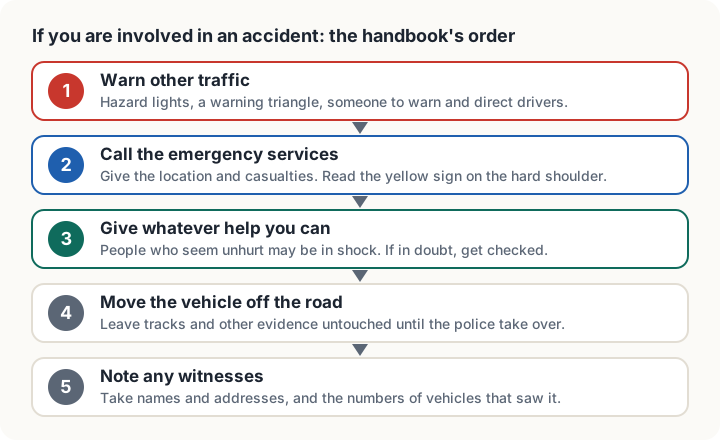
Fig. Figure 5.1At the scene, in the handbook’s order. Original illustration, based on Handbook §5.7.1, pp. 102–103 · not yet independently checked
At the scene, in the handbook’s order
The picture puts the handbook’s guidance for a driver involved in an accident into the order in which the text gives it. The handbook does not number these steps, and step 4 comes from a sentence that is partly garbled in the original, so check the details with your instructor.
Source: Handbook §5.7.1, pp. 102–103
Check against current rules. This point could not be fully verified or may have changed since the 2018 handbook.
Section 11 of 12
At an accident: helping, your duties and passing by
What the 2018 handbook says about helping others, your obligations before you leave, and how to behave when you pass an accident that others are already handling.
Source: Handbook §5.7.1, pp. 102–103
Note
Check against current rules
Helping others, and shock
Give whatever help you can to others involved. People who seem unhurt may be suffering from shock and may be unaware of their injuries, and that includes you. If in doubt, get checked at the hospital.
The handbook suggests that perhaps as many as a quarter of accident victims could have been saved by first aid from fellow road users, and asks those certified in first aid to be prepared to give it. This is 2018 guidance, not first-aid training.
Source: Handbook §5.7.1, pp. 102–103
Check against current rules. This point could not be fully verified or may have changed since the 2018 handbook.
Rule
Check against current rules
Duties after an accident (as stated in 2018)
The handbook sets out these obligations. They are legal guidance from October 2018 and may have changed, so confirm the current rules with an official source.
Leaving the scene without giving your name and telephone number is described as a serious offence that may lead to disqualification from driving and a prison term.
Move the vehicle off the road so that it is not a danger or obstruction to other traffic.
Tracks on the road, or anything else that may help the authorities’ inquiry, must stay intact until the police take over.
If you damage a sign, marking, traffic light or other traffic-control device, restore it if you can. If not, warn other road users, then notify the police and the responsible authority.
If you run into a parked car, try to contact the owner. If you cannot, leave your name and telephone number, then notify the police.
Source: Handbook §5.7.1, p. 103
Check against current rules. This point could not be fully verified or may have changed since the 2018 handbook.
Steps
Check against current rules
Note any witnesses
Make sure witnesses do not leave before you have their names and addresses. Also note the numbers of any vehicles whose occupants might have seen the accident.
Source: Handbook §5.7.1, p. 103
Check against current rules. This point could not be fully verified or may have changed since the 2018 handbook.
Rule
Passing an accident that is already being handled
If you are not one of the first to arrive and enough people have already stopped to help, drive past carefully and do not let the accident distract you.
Accident on the other side of a motorway: do not slow down to look.
Slowing to look may cause another accident on your side of the road or, at the very least, unnecessary congestion.
Always give way to emergency vehicles. Watch for their flashing lights and listen for their sirens.
Source: Handbook §5.7.1, p. 103
Section 12 of 12
Fire, and dealing with those involved
A small fire may be put out with an extinguisher; a serious one is for the fire brigade. The handbook’s casualty guidance is reported here as printed.
Source: Handbook §5.7.2, p. 104
Rule
Vehicle fire
Carrying a suitable fire extinguisher in your vehicle may help you put out a small fire. If the fire appears to be a serious one, do not try to tackle it: get well clear of the vehicle and leave it to the fire brigade.
If you suspect a fire in the engine compartment, get all passengers out safely.
Fire can spread through a vehicle with alarming speed.
Source: Handbook §5.7.2, p. 104
Note
One person takes charge
The panic that comes with an accident is often extremely stressful. If possible, one person should take charge of getting assistance and of alerting other road users by setting out triangular hazard signs. However confusing the situation is, try to stay as calm as possible.
Source: Handbook §5.7.2, p. 104
Important
Check against current rules
Casualties (2018 handbook guidance)
This is what the 2018 handbook says about injured people. It is not first-aid training, and first-aid advice may have been updated since, so follow the instructions of the emergency services.
Casualties should not be moved unless they could be run over by other vehicles or there is a risk of fire or explosion.
Do not remove a motorcyclist’s helmet unless it is essential to do so.
Casualties should go to hospital in an ambulance and be moved as little as possible.
When the ambulance arrives, give the crew as many facts as you can, but no assumptions or diagnoses.
Source: Handbook §5.7.2, p. 104
Check against current rules. This point could not be fully verified or may have changed since the 2018 handbook.
Chapter 5 recap
Remember this
Speeding is named as the principal cause of accidents; the root cause is a lack of road courtesy.
A green light does not prove the junction is clear, and it is not a reason to speed through.
It is always permissible to refrain from overtaking.
Overtaking accidents typically start with a restricted view or a misjudged speed and distance.
A properly designed roundabout is the safest type of junction.
Reducing speed does not eliminate accidents, but it greatly reduces their severity.
Animals on the road: slow to a crawl at once, then move forward slowly. Expect them most at dawn and dusk.
At an accident, warn other traffic first: hazard lights, warning triangle, someone to direct drivers.
Serious vehicle fire: do not tackle it. Get well clear and leave it to the fire brigade.
Common misconceptions
Myth
: If my light is green, the intersection must be clear.
Fact
: Believing the intersection was clear because the light was green is one of the listed causes of junction accidents. So is expecting everyone else to follow the rules.
Source: Handbook §5.2.2, p. 92
Myth
: A pedestrian crossing is always a safe place, so I need not slow much for one.
Fact
: The handbook says a crossing can be very unsafe, because the pedestrian feels safe and becomes less careful. Cars must slow down before entering a pedestrian crossing.
Source: Handbook §5.3, p. 98
Myth
: The highway is fenced, so there will be no camels on it.
Fact
: Even where there is a protective fence or barrier, camels may find a way through a gap, and where the fence ends livestock can easily reach the road.
Source: Handbook §5.4, p. 99
Myth
: Driving more slowly means I will not have an accident.
Fact
: Reducing speed will not eliminate accidents. What it does is greatly reduce how severe an accident is, for you and for everyone else involved.
Source: Handbook §5.3, p. 98
Myth
: I should always slow down or stop when I pass an accident.
Fact
: If enough people have already stopped to help, drive past carefully without being distracted. If the accident is on the other side of a motorway, do not slow down to look.
Source: Handbook §5.7.1, p. 103
Chapter 5 · practice
Check your knowledge
6 quick questions on this chapter, with an explanation after each answer. Or practise all 13 questions written for it.