हैंडबुक के परिशिष्ट में इस समूह की हर प्रविष्टि, उसकी तस्वीर, हैंडबुक नंबर, नाम और अर्थ के साथ।
हैंडबुक क्या कहती है
Broken lines advise, continuous lines prohibit
A broken line works as a recommendation, a warning or a guide. A continuous line is a prohibitive line: you must not cross or straddle a continuous line that divides two lanes.
General rule: the more paint, the more important the message.
Markings may warn of danger, divide lanes, separate a cycle track or footway, or signal a prohibition.
स्रोत: Handbook §1.3, p. 16
Why markings are useful
Markings can still be seen when a sign is hidden behind other traffic, and they keep giving their message continuously as you drive along. Besides lines you will meet arrows, studs, symbols and text.
Stop lines indicate where you must stop at a road sign or traffic light.
स्रोत: Handbook Appendix: Road markings, p. 217
601601. Give Way line or Yield line
The yield symbol amplifies the message conveyed by the give way sign.
स्रोत: Handbook Appendix: Road markings, p. 217
602602. Pedestrian crossing
Indicated by road markings and road signs or traffic lights.
स्रोत: Handbook Appendix: Road markings, p. 217
603603. Cycle track
Indicated by a cycle track line.
स्रोत: Handbook Appendix: Road markings, p. 217
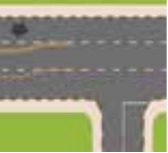
604604. Advance warning of liability to Give Way
Indicates and warns you of a Give Way sign posted up the road.
स्रोत: Handbook Appendix: Road markings, p. 217
Lines along the road
99 प्रविष्टियाँ
605605. Centerline
This broken line marks the center of the road. On main roads, each individual marking is 3 metres long. The distance between markings is 9 metres. In built-up areas, the dashes marking out the centerline may be spaced more closely together.
स्रोत: Handbook Appendix: Road markings, p. 218
606606. Lane lines
Broken lane lines divide the carriageway into two or more lanes of traffic traveling in the same direction. In built-up areas, the dashes marking out the lane lines may be spaced more closely together.
स्रोत: Handbook Appendix: Road markings, p. 218
607607. Prohibitory line
Crossing or straddling a prohibitory line is forbidden, even by a single wheel. Never cross this line unless there is a broken centerline between you and the prohibitory line.
स्रोत: Handbook Appendix: Road markings, p. 218
608608. Warning line
On roads that are less than 7 metres wide, warning lines are used instead of center and prohibitory lines. They may also be used on wider roads in built-up areas or give warning of a prohibitory line or hazard ahead. Crossing a warning line is prohibited unless you are certain that the road is clear. Each individual marking is 9 metres long. The distance between them is 3 metres.
स्रोत: Handbook Appendix: Road markings, p. 218
609609. Double prohibitory line
These lines are normally used on carriageways with two lanes of traffic in each direction. Where necessary, double prohibitory lines are also used on roads with only one lane in each direction. Crossing or straddling a double prohibitory line is always prohibited.
स्रोत: Handbook Appendix: Road markings, p. 219
610610. Direction line
Indicates how vehicles should turn and how to be able to keep your lane and to better position your vehicle through intersections and roundabouts.
स्रोत: Handbook Appendix: Road markings, p. 219
611611. Edge line
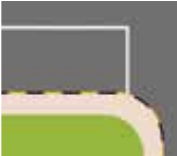
The edge of the road is usually marked with a broken line. Crossing a broken edge line is permitted wherever you may temporarily need to drive onto the shoulder, e.g. to help another vehicle overtake.Edge lines are normally white but sometime can be yellow.
स्रोत: Handbook Appendix: Road markings, p. 219
612612. Continuous edge line
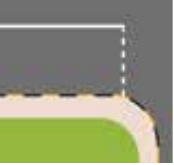
Used on motorways where driving on the shoulder is considered unsuitable. Motor vehicles should therefore never straddle or cross a continuous edge line. Continuous edge lines are normally white but sometime can be yellow.
स्रोत: Handbook Appendix: Road markings, p. 219
613613. Restricted area
Crossing or straddling a restricted area is prohibited. The smaller of such areas are painted solid white.
स्रोत: Handbook Appendix: Road markings, p. 219
Combination of lines along the road
33 प्रविष्टियाँ
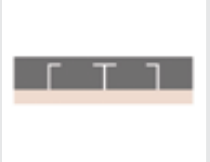
614614. Centreline and prohibitory line
This combination of lines indicates that visibility is restricted.
स्रोत: Handbook Appendix: Road markings, p. 220
615615. Warning line and centerline
You may cross the lines only if you can see the road is clear and you know you can cross in safety.
स्रोत: Handbook Appendix: Road markings, p. 220
616616. Warning line and prohibitory line
This combination of lines gives warning of a prohibitory line or a hazard up ahead.
स्रोत: Handbook Appendix: Road markings, p. 220
Reflective studs or cat's eyes
11 प्रविष्टि
हैंडबुक में कोई चित्र नहीं
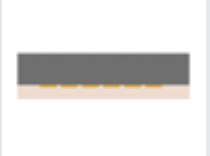
617617. Reflective studs or cat's eyes
These are white reflective studs, popularly known as cat's eyes, spaced in a row between lanes, lane lines or as a center-of-road line. There are flashing amber cat's eyes to warn drivers that they are approaching a pedestrian crossing. At road works, cat's eyes may be used to help identify the lanes that are in operation.
स्रोत: Handbook Appendix: Road markings, p. 220
Lanes for specific types of vehicle
22 प्रविष्टियाँ
618618. Reserved lane line
Used to separate lanes reserved for scheduled vehicles.
स्रोत: Handbook Appendix: Road markings, p. 221
619619. Cycle lane line
This line separates cycle tracks from other lanes. Cyclists must use cycle tracks, if provided. In some cases, cyclists are protected from other traffic by a prohibitory line (607).
स्रोत: Handbook Appendix: Road markings, p. 221
Words on the road, road numbers and destination markings
11 प्रविष्टि
620620. Text
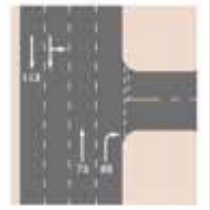
Text may sometimes be used to amplify the message conveyed by a line, usually with a clear meaning such as STOP, SLOW, KEEP CLEAR or U-TURN ONLY . Sometimes lanes have destination markings or road numbers on the road surface. These enable drivers to get into the correct lane early.
स्रोत: Handbook Appendix: Road markings, p. 221
Lane arrows
22 प्रविष्टियाँ
621-625621-625. Lane arrows
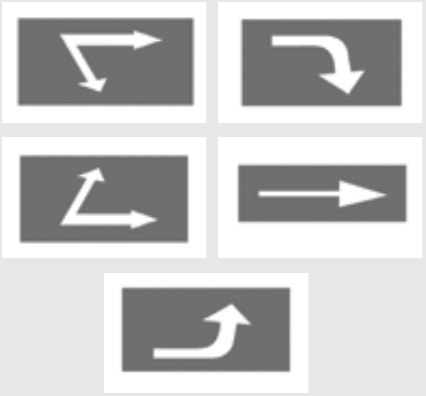
This series of arrows indicate the lane you must or should take. If prohibitory lines border the lane, you must follow the direction indicated by the arrow(s). The arrow otherwise serves to suggest an appropriate choice of route.
स्रोत: Handbook Appendix: Road markings, p. 222
626626. Lane change markings
Lane change markings warn you to get in lane in time and to watch out for traffic merging with your lane up ahead.
स्रोत: Handbook Appendix: Road markings, p. 222
Speed reduction lines
11 प्रविष्टि
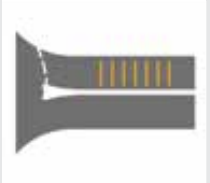
627627. Speed reduction lines
Raised yellow lines may be painted across the carriageway as speed reducers. The purpose of these yellow lines is to make drivers aware of their speed after a period of driving at higher speeds. Reduce your speed in good time. They are sometime painted at the approach to roundabouts or speed humps, on the hard shoulder, or when entering a village or approaching a particular hazard. Reduce your speed in good time.
स्रोत: Handbook Appendix: Road markings, p. 222
Temporary road markings
11 प्रविष्टि
628628. Temporary road markings, yellow reflective studs or cat’s eyes
May be used to help identify the lanes in operation at road works. Orange or yellow road marking colors are being used. Temporary road markings have precedence over ordinary road markings. They serve as lane lines and prohibitory lines and are used to mark the edge of the carriageway in conjunction with road works, etc.
स्रोत: Handbook Appendix: Road markings, p. 223
Parking related road markings
44 प्रविष्टियाँ
629629. Parking spaces
Marked with continuous or broken white lines. All four wheels of parked cars must be within the lines.
स्रोत: Handbook Appendix: Road markings, p. 223
630630. Parking spaces reserved for disabled persons
Only persons holding special permits may park in spaces marked this way.
स्रोत: Handbook Appendix: Road markings, p. 223
631631. Parking prohibited
Indicated by a broken yellow curbside line. Used at bus stops and on curbstones at junctions.
स्रोत: Handbook Appendix: Road markings, p. 223
632-633632-633. No stopping or parking
This prohibition is sometimes used with a continuous yellow line and may appear at certain bus stops. (632) may be combined with a zigzag line or yellow cross lines marked on the carriageway. This marking may also be used instead of a broken curbside line to indicate that parking is prohibited. (633)
स्रोत: Handbook Appendix: Road markings, p. 223
Box junctions
11 प्रविष्टि
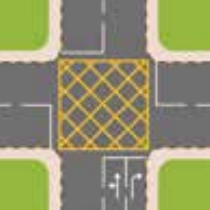
634634. Box junctions
Yellow crisscross lines mark a box junction. Their purpose is to keep the junction clear by preventing traffic from stopping in the path of crossing traffic. You must not enter a box junction unless your exit road is clear. But you can enter the box when you want to turn left end you are only prevented from doing so by oncoming traffic. If there is a vehicle already on the junction waiting to turn left, you are free to enter behind it and wait to turn left providing that you will not block any oncoming traffic wanting to turn left. If there are a number of vehicles waiting to turn, it is unlikely you will be able to proceed before the traffic signals change, so you should wait for the next clear opportunity before entering the box.
स्रोत: Handbook Appendix: Road markings, p. 224
चित्र और शब्द एमिरेट्स ड्राइविंग कंपनी की लाइट व्हीकल हैंडबुक (संस्करण 1.2) से लिए गए हैं, जिसमें लिखा है कि कुछ संकेत यूएई में इस्तेमाल नहीं होते। आज सड़क पर लगे संकेत अलग हो सकते हैं; हमेशा उन संकेतों का पालन करें जो आप सचमुच देखते हैं, और मौजूदा आधिकारिक मार्गदर्शन का।