This short appendix is about how you see risk. It explains where your sense of danger comes from, asks you some honest questions about your own driving, names the four skills of hazard perception and then lets you practise spotting hazards in pictures. Use it as a revision exercise once you have studied the chapters.
প্রায় 8 মিনিট
4টি অংশ
Handbook Appendix: Avoiding danger on the road, pp. 177–181
অধ্যায় 9 · 4টি অংশ
এই অধ্যায়ের পরে আপনি পারবেন
State the aim of the appendix: to define, understand, calculate and avoid risk.
List the four things our perception of hazard and risk is based on.
Name the four hazard perception skills the handbook tells you to learn.
Explain why the hazards you do not see are the most dangerous.
Use the hazard challenge pictures to practise counting potential hazards.
4টির মধ্যে অংশ 1
Perception of hazard and risk
The handbook lists four things that shape how each of us perceives hazard and risk.
সূত্র: Handbook Appendix: Avoiding danger on the road, p. 177
অ্যানিমেটেড ছবি · মৌলিক অলংকরণ
One hazard, four things that shape how you see it
A straight two-way desert road with sand on both sides. Car A, the blue car you are driving, heads east. Ahead of it a camel stands on the sand close to the right-hand edge of the road. Beside the road lies a panel of four lamps named Experience, Beliefs, Control and Information.
ছবিতে ফোকাস করুন, তারপর: ডান তীর বা N পরের ধাপে নেয়, বাঁ তীর বা B এক ধাপ পিছিয়ে যায়। R প্রথম ধাপ থেকে আবার চালায়। D, 3D মডেল আর 2D নকশার মধ্যে বদলায়। কমা আর দাঁড়ি 3D মডেল ঘোরায়, উপর ও নিচের তীর এটি হেলায়, প্লাস ও মাইনাস জুম করে, 0 দৃশ্য রিসেট করে। প্রতিটি ধাপ নিয়ন্ত্রণের জন্য একটি বোতামও আছে।
Step 1 of 6, A camel near the road: Car A drives east on a desert road. A camel stands on the sand ahead, close to the edge. How risky does that look to you?
ধাপ 1 / 6
A camel near the road
Car A drives east on a desert road. A camel stands on the sand ahead, close to the edge. How risky does that look to you?
সূত্র: Handbook Appendix: Avoiding danger on the road, p. 177
নোট
What this appendix is for
The handbook’s stated aim here is to give you a framework for analysing the risk you face on the road. It sets out to do four things with risk: define it, understand it, calculate it and avoid it.
সূত্র: Handbook Appendix: Avoiding danger on the road, p. 177
সংজ্ঞা
Where your sense of risk comes from
The handbook asks where the way we perceive hazard and risk comes from. Its answer is that our perceptions are based on four things.
Personal experience of the adverse event.
Social and cultural background and beliefs.
Our ability to exercise control over a particular risk.
The extent to which information is gained from different sources, for example from the media.
সূত্র: Handbook Appendix: Avoiding danger on the road, p. 177
4টির মধ্যে অংশ 2
Questions to ask yourself
A short self-assessment about why crashes happen and how risky your own habits are. The handbook gives no answers.
সূত্র: Handbook Appendix: Avoiding danger on the road, p. 177
অ্যানিমেটেড ছবি · মৌলিক অলংকরণ
The self-check at a yellow light
A model crossroads with traffic lights. Car A, the blue car you are driving, comes from the south towards a green light. Car B waits at a red light on the road from the west, and a pedestrian waits at the kerb beside a crossing in front of car A.
ছবিতে ফোকাস করুন, তারপর: ডান তীর বা N পরের ধাপে নেয়, বাঁ তীর বা B এক ধাপ পিছিয়ে যায়। R প্রথম ধাপ থেকে আবার চালায়। D, 3D মডেল আর 2D নকশার মধ্যে বদলায়। কমা আর দাঁড়ি 3D মডেল ঘোরায়, উপর ও নিচের তীর এটি হেলায়, প্লাস ও মাইনাস জুম করে, 0 দৃশ্য রিসেট করে। প্রতিটি ধাপ নিয়ন্ত্রণের জন্য একটি বোতামও আছে।
Step 1 of 5, A green light ahead: Car A drives towards a crossroads on green. Car B waits at a red light on the left and a pedestrian waits to cross.
ধাপ 1 / 5
A green light ahead
Car A drives towards a crossroads on green. Car B waits at a red light on the left and a pedestrian waits to cross.
সূত্র: Handbook Appendix: Avoiding danger on the road, p. 177
ধাপ
How to answer the self-check
The questionnaire only helps if it shows what you really think. The handbook gives three instructions.
1Do not spend too much time thinking about the answer.
2If you are unsure, give your first preference answer.
3Be honest.
সূত্র: Handbook Appendix: Avoiding danger on the road, p. 177
নোট
Why do drivers crash, and what would help?
The first questions ask for your opinion. There is no right answer printed; the point is to notice what you believe.
Why do drivers crash? The choices offered are inadequate training, carelessness, a licensing test that needs improvement, bad road design, poor understanding of the dangers involved in driving, or something else.
How can driving be improved? The choices are more police enforcement, better signage on the road, better education and training, improved licensing standards, or something else.
When travelling by car, do you wear your seat belt always, sometimes or never?
সূত্র: Handbook Appendix: Avoiding danger on the road, p. 177
নোট
Four questions about your own driving
The handbook then asks four questions about driving and leaves them unanswered. Try them honestly, then look up stopping distance and crash forces in the chapter on safety while driving.
Is driving 15 km/h above the speed limit risky?
Is running a yellow light risky, OK, or are you not sure?
If you need to stop suddenly from 60 km/h, how much distance do you need?
If you crash your car at 60 km/h, what height of fall would the impact on your body be equivalent to?
সূত্র: Handbook Appendix: Avoiding danger on the road, p. 177
4টির মধ্যে অংশ 3
Hazard perception
Seeing a hazard in time can be the difference between life and death. It is a skill you learn.
সূত্র: Handbook Appendix: Avoiding danger on the road, p. 178
অ্যানিমেটেড ছবি · মৌলিক অলংকরণ
Scan, process, prioritize, take action
A straight two-way town street. Car A, the blue car you are driving, heads east. On the other side of the road a bus has stopped at a bus stop, facing west. A pedestrian stands on the pavement just behind the bus, where the driver of car A cannot see them. A cyclist rides east far ahead of car A.
ছবিতে ফোকাস করুন, তারপর: ডান তীর বা N পরের ধাপে নেয়, বাঁ তীর বা B এক ধাপ পিছিয়ে যায়। R প্রথম ধাপ থেকে আবার চালায়। D, 3D মডেল আর 2D নকশার মধ্যে বদলায়। কমা আর দাঁড়ি 3D মডেল ঘোরায়, উপর ও নিচের তীর এটি হেলায়, প্লাস ও মাইনাস জুম করে, 0 দৃশ্য রিসেট করে। প্রতিটি ধাপ নিয়ন্ত্রণের জন্য একটি বোতামও আছে।
Step 1 of 6, A bus at its stop: Car A drives east. Across the road a bus has stopped at a bus stop, and a cyclist rides far ahead.
ধাপ 1 / 6
A bus at its stop
Car A drives east. Across the road a bus has stopped at a bus stop, and a cyclist rides far ahead.
সূত্র: Handbook Appendix: Avoiding danger on the road, p. 178
গুরুত্বপূর্ণ
The hazards you do not see
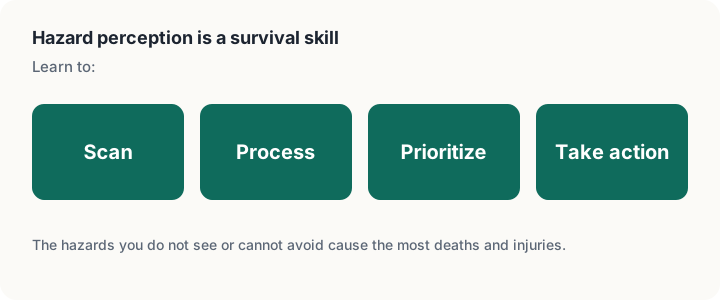
Perceiving a hazard can mean the difference between life and death. The handbook says it is the hazards you do not see, or cannot avoid, that cause the most deaths and injuries.
সূত্র: Handbook Appendix: Avoiding danger on the road, p. 178
সচিত্র
চিত্র 9.1চিত্র 9.1A survival skill in four parts. মূল অলংকরণ, Handbook Appendix: Avoiding danger on the road, p. 178 অবলম্বনে
A survival skill in four parts
The handbook calls hazard perception a survival skill and tells you to learn four things. It lists them without further explanation.
Scan.
Process.
Prioritize.
Take action.
সূত্র: Handbook Appendix: Avoiding danger on the road, p. 178
4টির মধ্যে অংশ 4
The hazard challenge
Eight pictures to practise on. Count the potential hazards in each one.
সূত্র: Handbook Appendix: Avoiding danger on the road, pp. 178–181
অ্যানিমেটেড ছবি · মৌলিক অলংকরণ
Counting potential hazards: a practice picture
Rain
A practice picture of our own, not one of the handbook’s eight: a T-junction with a stop sign in the rain. Car A, the blue car you are driving, comes up the side road from the south. On the main road car B comes from the west and a motorcycle comes from the east. A pedestrian waits at the corner to cross the mouth of the side road.
ছবিতে ফোকাস করুন, তারপর: ডান তীর বা N পরের ধাপে নেয়, বাঁ তীর বা B এক ধাপ পিছিয়ে যায়। R প্রথম ধাপ থেকে আবার চালায়। D, 3D মডেল আর 2D নকশার মধ্যে বদলায়। কমা আর দাঁড়ি 3D মডেল ঘোরায়, উপর ও নিচের তীর এটি হেলায়, প্লাস ও মাইনাস জুম করে, 0 দৃশ্য রিসেট করে। প্রতিটি ধাপ নিয়ন্ত্রণের জন্য একটি বোতামও আছে।
Step 1 of 6, How many hazards can you see?: A practice picture of our own: car A nears a T-junction with a stop sign in the rain. Count the potential hazards, then go on. Conditions: Rain.
ধাপ 1 / 6
How many hazards can you see?
A practice picture of our own: car A nears a T-junction with a stop sign in the rain. Count the potential hazards, then go on.
সূত্র: Handbook Appendix: Avoiding danger on the road, p. 178
সূত্র: Handbook Appendix: Avoiding danger on the road, pp. 178–181Scene descriptions are our own reading of uncaptioned pictures; the handbook gives no answer key.
ধাপ
How the challenge works
Each picture comes with the same question: how many hazards can you see? You count the number of potential hazards in each picture, from zero to five, and write them down. The handbook prints no answers, so compare your list with your instructor or another learner.
সূত্র: Handbook Appendix: Avoiding danger on the road, p. 178
উদাহরণ
বর্তমান নিয়মের সঙ্গে যাচাই করুন
The eight scenes
Open your handbook at pages 178 to 181 and work through the pictures. These short descriptions are ours, only to help you find each one; they do not tell you what the hazards are.
Page 178: a busy road in rain by day, and a rainy night seen through a wet windscreen.
Page 179: a pedestrian on a marked crossing with a car close by, and a crossroads with traffic lights and a yellow box.
Page 180: a T-junction with a stop sign, and a multi-lane road where another road joins.
Page 181: a crossroads, and a roundabout.
সূত্র: Handbook Appendix: Avoiding danger on the road, pp. 178–181Scene descriptions are our own reading of uncaptioned pictures; the handbook gives no answer key.
বর্তমান নিয়মের সঙ্গে যাচাই করুন। এই বিষয়টি পুরোপুরি যাচাই করা যায়নি, অথবা বদলে গিয়ে থাকতে পারে।
অধ্যায় 9-এর সারাংশ
এটি মনে রাখুন
The aim: define, understand, calculate and avoid risk.
Your sense of risk comes from personal experience, background and beliefs, how much control you feel you have, and what you hear from sources such as the media.
Hazard perception is a survival skill: scan, process, prioritize, take action.
The hazards you do not see or cannot avoid cause the most deaths and injuries.
Answer the self-check quickly and honestly; the handbook gives no answer key.
প্রচলিত ভুল ধারণা
ভুল ধারণা
: My sense of how risky something is comes purely from the facts of the situation.
সত্য
: The handbook says our perceptions of hazard and risk are based on personal experience of the adverse event, social and cultural background and beliefs, our ability to exercise control over the risk, and information gained from sources such as the media.
সূত্র: Handbook Appendix: Avoiding danger on the road, p. 177
ভুল ধারণা
: The obvious hazards are the ones that hurt people.
সত্য
: According to the handbook, it is the hazards you do not see or cannot avoid that cause the most deaths and injuries.
সূত্র: Handbook Appendix: Avoiding danger on the road, p. 178
ভুল ধারণা
: Spotting hazards is a talent that some drivers simply have.
সত্য
: The handbook treats hazard perception as a survival skill to be learned: scan, process, prioritize and take action.
সূত্র: Handbook Appendix: Avoiding danger on the road, p. 178
অধ্যায় 9 · অনুশীলন
আপনার জ্ঞান যাচাই করুন
এই অধ্যায়ে 6টি ছোট প্রশ্ন, প্রতিটি উত্তরের পরে ব্যাখ্যাসহ। অথবা এর জন্য লেখা সব 7টি প্রশ্ন অনুশীলন করুন।