Signs, markings and rules are what let thousands of strangers share a road safely. This chapter covers the six sign groups, what road markings mean, where to position your car, who gives way to whom, how to treat emergency vehicles and pedestrians, and how to signal clearly.
About 25 minutes
12 sections
Handbook Chapter 1, pp. 13–32
Chapter 1 · 12 sections
After this chapter you can
Recognise the six groups of road signs by shape and colour.
Explain the difference between broken and continuous road markings.
Position the car correctly when going straight, turning right and turning left.
Apply the Left Hand, Main Road, Exit or Entering and Turning rules.
State the order of precedence between police signals, traffic lights, signs and rules.
Use indicators, horn, hazard lights and brake lights correctly.
Describe what each traffic-light state requires of you.
Section 1 of 12
Why traffic rules exist
Uniform rules let traffic flow and let the police and courts decide who was at fault.
Source: Handbook §1.1, p. 13
Animated visual · Original illustration
One set of rules for everyone
A two-way street with a centre line and a road sign. Car A, the blue car you are driving, heads east. Bus B comes the other way and a pedestrian walks along the pavement.
Focus the picture, then: Right arrow or N moves to the next step, Left arrow or B goes back a step. R replays from the first step. D switches between the 3D model and the 2D diagram. Comma and full stop turn the 3D model, Up and Down arrows tilt it, plus and minus zoom, 0 resets the view. Every step control also has a button.
Step 1 of 5, A shared road: Cars, buses and pedestrians use the same street, so they all have to follow the same rules.
Step 1 of 5
A shared road
Cars, buses and pedestrians use the same street, so they all have to follow the same rules.
Source: Handbook §1.1, p. 13
Note
One set of rules for everyone
Vehicles and pedestrians are found almost everywhere in the UAE, so every road user has to follow the same rules. Traffic law covers three things: how roads are signed and marked, how vehicles must be equipped, and how drivers must behave.
The rules guide you towards correct behaviour, and they also help the police and judiciary decide who was right and who was wrong after an accident.
Rules, signs and markings together regulate traffic.
Knowing the rules stops you breaking them through carelessness or ignorance.
Some signs and lines in the handbook are not yet common in the UAE, but you need them if you drive abroad.
Source: Handbook §1.1, p. 13
Section 2 of 12
Road sign groups
Learn the six groups by shape and colour first; individual signs then become much easier to remember.
Source: Handbook §1.2.1, pp. 14–15
Animated visual · Original illustration
Six sign groups by shape and colour
An empty table on which road signs are stood up one at a time, from left to right: a red-edged triangle, a blue circle, a red circle, a rectangular signpost, a small rectangular plate under the first sign, and a sign on an orange background.
Focus the picture, then: Right arrow or N moves to the next step, Left arrow or B goes back a step. R replays from the first step. D switches between the 3D model and the 2D diagram. Comma and full stop turn the 3D model, Up and Down arrows tilt it, plus and minus zoom, 0 resets the view. Every step control also has a button.
Step 1 of 6, Warning signs: A triangular sign is a warning sign. It offers a caution about what is ahead.
Step 1 of 6
Warning signs
A triangular sign is a warning sign. It offers a caution about what is ahead.
Source: Handbook §1.2.1, p. 15
Note
What signs are for
Signs tell you the rules you must obey and warn you about hazards ahead. A sign only works if it gives its message clearly and early enough for you to see it, understand it and act.
Because we drive on the right, most signs stand on the right-hand side of the road. Some also appear on the left where that suits the road better.
Symbols are used wherever possible because they are understood whatever language you speak.
Each sign has its own combination of shape, colour and symbol.
Signs can be panels, road markings, beacons, bollards or traffic lights.
Source: Handbook §1.2.1, p. 14
Illustrated
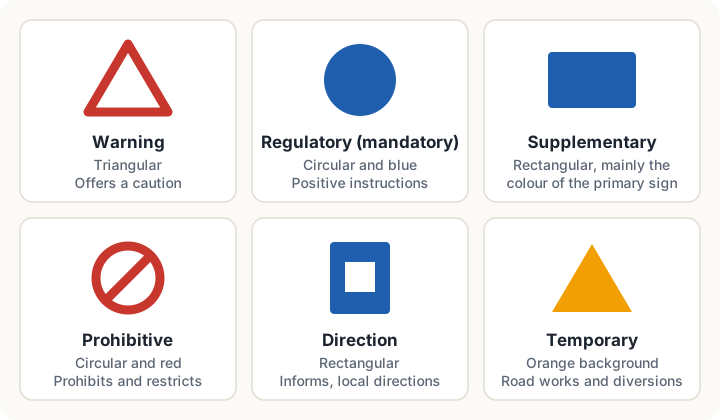
Fig. 1.1Figure 1.1The six sign groups. Original illustration, based on Handbook §1.2.1, p. 15
The six sign groups
Shape and colour tell you what kind of message a sign carries before you can even read it.
Warning signs: triangular. They offer a caution.
Regulatory (mandatory) signs: circular and blue. They give positive instructions.
Prohibitive signs: circular and red. They prohibit and restrict.
Direction signs: rectangular. They inform and give local directions.
Supplementary signs: rectangular, mainly the same colour as the sign they accompany.
Temporary signs: on an orange background.
Source: Handbook §1.2.1, p. 15
Section 3 of 12
Road markings
Lines, arrows, studs and words painted on the road. Broken lines advise; continuous lines prohibit.
Source: Handbook §1.3, p. 16
Animated visual · Original illustration
Broken lines advise, continuous lines prohibit
A road with two lanes heading east and one heading west. A broken line divides the two eastbound lanes and a continuous line divides them from the oncoming lane. Car A, the blue car you are driving, uses the right-hand lane and car B the lane beside it. Car C comes the other way.
Focus the picture, then: Right arrow or N moves to the next step, Left arrow or B goes back a step. R replays from the first step. D switches between the 3D model and the 2D diagram. Comma and full stop turn the 3D model, Up and Down arrows tilt it, plus and minus zoom, 0 resets the view. Every step control also has a button.
Step 1 of 5, Two kinds of line: The line between the two eastbound lanes is broken. The line next to the oncoming lane is continuous.
Step 1 of 5
Two kinds of line
The line between the two eastbound lanes is broken. The line next to the oncoming lane is continuous.
Source: Handbook §1.3, p. 16
Rule
Broken lines advise, continuous lines prohibit
A broken line works as a recommendation, a warning or a guide. A continuous line is a prohibitive line: you must not cross or straddle a continuous line that divides two lanes.
General rule: the more paint, the more important the message.
Markings may warn of danger, divide lanes, separate a cycle track or footway, or signal a prohibition.
Source: Handbook §1.3, p. 16
Note
Why markings are useful
Markings can still be seen when a sign is hidden behind other traffic, and they keep giving their message continuously as you drive along. Besides lines you will meet arrows, studs, symbols and text.
Source: Handbook §1.3, p. 16
Section 4 of 12
Basic positioning
Where to place the car on the road when driving straight, turning, meeting oncoming traffic and following another vehicle.
Source: Handbook §1.4, pp. 17–19
Animated visual · Original illustration
An obstacle on your side of a narrow road
A narrow two-way road. Barriers and cones block the eastbound lane ahead of car A, the blue car you are driving. Car B comes the other way in its own lane.
Focus the picture, then: Right arrow or N moves to the next step, Left arrow or B goes back a step. R replays from the first step. D switches between the 3D model and the 2D diagram. Comma and full stop turn the 3D model, Up and Down arrows tilt it, plus and minus zoom, 0 resets the view. Every step control also has a button.
Step 1 of 5, A narrow road: Car A and car B are about to meet. The narrower the road, the greater the risk when two vehicles meet.
Step 1 of 5
A narrow road
Car A and car B are about to meet. The narrower the road, the greater the risk when two vehicles meet.
Source: Handbook §1.4.5, p. 18
Rule
Keep to the right
On a two-way road, drive in the lane furthest to the right as seen in your direction of travel, leaving space for faster vehicles. Position the car so that you could cope safely with a sudden overtake or an unexpected oncoming vehicle.
Going straight ahead: use the right-hand lane wherever possible.
Overtaking and meeting oncoming vehicles always carry some risk.
The risk is much greater when a hill or bend hides the road, or at night, in fog or in rain.
Source: Handbook §1.4.1, p. 17
Rule
Turning right: stay close to the right edge
Before a right turn, keep as close to the right-hand edge of the carriageway as traffic allows, and stay as far right as possible through the turn. This helps the vehicles on your left and stops other drivers creeping up on your right.
Source: Handbook §1.4.3, p. 17
Rule
Turning left: close to the centre line, and give way
On a two-way road, position close to the centre line before turning left and check the road in both directions. You must give way to all oncoming traffic.
A left turn at a junction is only allowed if you can make it safely without obstructing oncoming traffic or vehicles coming up from behind.
Source: Handbook §1.4.4, p. 18
Rule
Meeting oncoming traffic on a narrow road
The narrower the road, the greater the risk when two vehicles meet. Where possible, one driver should stop and wait. If there is an obstacle ahead on your side of the road, you are the one who gives way to vehicles coming the other way.
Drivers tend to judge the meeting point as further away than it really is.
The meeting point is only halfway between you if both vehicles travel at exactly the same speed.
Source: Handbook §1.4.5, p. 18
Example
When an oncoming vehicle is in your lane
The handbook gives a set response for each of these situations.
An oncoming car starts overtaking a line of vehicles: keep right, slow down and flash your headlights.
A vehicle comes towards you in the wrong lane: brake firmly, flash your headlights repeatedly and use the horn. Steer to the right only as a last resort.
Several heavy vehicles are coming over a hilltop: be ready to steer right, slow down and flash your headlights, because a driver behind them may risk overtaking.
An oncoming car starts to skid: slow down, keep well clear and do not slam on the brakes.
Source: Handbook §1.4.5, p. 19
Rule
Distance to the car in front
Driving close behind another vehicle raises the risk of a collision, hides the road ahead from you and makes your driving less smooth.
If someone is following so closely that you fear they will run into you, slow down slightly so that the gap between you and the vehicle ahead becomes larger. That bigger gap is your safety margin.
Source: Handbook §1.4.6, p. 19
Section 5 of 12
Rules of the road
The named right-of-way rules that apply when no officer, light or sign tells you what to do.
Source: Handbook §1.5, p. 20
Animated visual · Original illustration
The Obstruction Rule: keep the junction clear
A model crossroads with a pedestrian crossing on its far side. Two cars stand in a traffic jam just beyond the crossing. Car A, the blue car you are driving, comes from the south. Car C comes from the west, and a pedestrian waits at the crossing.
Focus the picture, then: Right arrow or N moves to the next step, Left arrow or B goes back a step. R replays from the first step. D switches between the 3D model and the 2D diagram. Comma and full stop turn the 3D model, Up and Down arrows tilt it, plus and minus zoom, 0 resets the view. Every step control also has a button.
Step 1 of 5, A traffic jam ahead: Car A nears a crossroads. On the far side, the queue has stopped just past the pedestrian crossing.
Step 1 of 5
A traffic jam ahead
Car A nears a crossroads. On the far side, the queue has stopped just past the pedestrian crossing.
Source: Handbook §1.5.5, p. 21
Illustrated
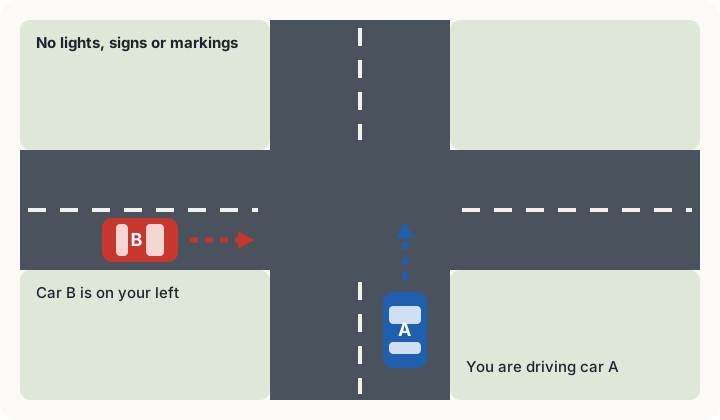
Fig. 1.2Figure 1.2The Left Hand Rule. Original illustration, based on Handbook §1.5.1, p. 20
The Left Hand Rule
At junctions and intersections that are not controlled by traffic lights or road markings, give priority to vehicles approaching from your left. The rule also applies in parking lots and public areas.
It does not apply where there is a Give Way or Stop sign. In the picture, car A must let car B go first.
When you enter a primary road, priority road or main road, or join an asphalt road from a gravel road, you must give way or stop for traffic approaching from both the left and the right.
Source: Handbook §1.5.2, p. 20
Rule
The Exit or Entering Rule
Give way to all other traffic whenever you come out of a parking lot, a petrol station, a residential area, a pedestrian way or the hard shoulder, or when you join the road from an off-road area.
Source: Handbook §1.5.3, p. 20
Rule
The Turning Rule
When you turn left at a crossroads you give way to oncoming motor vehicles and also to any pedestrians who may cross your path.
In a traffic jam, obstructing a crossroads or a walkway is prohibited. Do not stop where your car would block the junction or the pedestrian crossing.
Source: Handbook §1.5.5, p. 21
Rule
The Bus Rule
In cities or countries with public transport buses, a bus leaving a bus stop has priority inside the city limits. Let it pull out.
Source: Handbook §1.5.6, p. 21
Rule
The Zipper principle
Where two roads meet, such as at a T-junction, it makes road sense for one car from each road to move ahead in turn.
This is very common in the rush hour, at road works and in traffic jams. It is acceptable even where a road sign indicates that the approaching traffic has priority.
Source: Handbook §1.5.7, p. 21
Section 6 of 12
Emergency vehicles and convoys
Some vehicles are excluded from the normal rules. Your job is to make way.
Source: Handbook §1.6.1, p. 22
Animated visual · Original illustration
Making way for an emergency vehicle
A road with two lanes heading east. Car A, the blue car you are driving, is in the right-hand lane and car B is ahead in the left-hand lane. An emergency vehicle with its warning lamps on comes up behind them in the left-hand lane.
Focus the picture, then: Right arrow or N moves to the next step, Left arrow or B goes back a step. R replays from the first step. D switches between the 3D model and the 2D diagram. Comma and full stop turn the 3D model, Up and Down arrows tilt it, plus and minus zoom, 0 resets the view. Every step control also has a button.
Step 1 of 5, An emergency vehicle behind: An emergency vehicle on duty is coming up behind. It warns with a rotating flashing light, and sometimes a siren.
Step 1 of 5
An emergency vehicle behind
An emergency vehicle on duty is coming up behind. It warns with a rotating flashing light, and sometimes a siren.
Source: Handbook §1.6.1, p. 22
Rule
Always make way for emergency vehicles
Fire engines, ambulances and police vehicles on duty may break the normal rules, for example by passing a red light or going the wrong side of an island, provided they can do it safely. They warn you with a rotating flashing light, and sometimes a siren or strobe lights.
Slow down and pull over to the side of the road, stopping completely if necessary. Disrupting an emergency vehicle or forcing your way through is prohibited.
Source: Handbook §1.6.1, p. 22
Rule
Convoys also have priority
You are also required to give priority to military vehicles moving in convoy, official convoys and rescue vehicle convoys.
Source: Handbook §1.6.1, p. 22
Section 7 of 12
Pedestrians, cyclists and courtesy
Unprotected road users need space and patience. Treat other drivers the way you treat people face to face.
Source: Handbook §1.7, p. 23
Animated visual · Original illustration
A pedestrian waiting to cross
A road with a zebra crossing. A pedestrian waits on the pavement at the crossing. Van V heads east in the right-hand lane, and car A, the blue car you are driving, follows a little behind in the lane to its left. Car C comes the other way.
Focus the picture, then: Right arrow or N moves to the next step, Left arrow or B goes back a step. R replays from the first step. D switches between the 3D model and the 2D diagram. Comma and full stop turn the 3D model, Up and Down arrows tilt it, plus and minus zoom, 0 resets the view. Every step control also has a button.
Step 1 of 5, Someone is waiting: A pedestrian stands at the crossing, waiting to cross. Slow down as soon as you see this.
Step 1 of 5
Someone is waiting
A pedestrian stands at the crossing, waiting to cross. Slow down as soon as you see this.
Source: Handbook §1.7.1, p. 23
Definition
Controlled and uncontrolled crossings
A controlled pedestrian crossing is one controlled by a police officer or a traffic light. Every other crossing is uncontrolled, even if a traffic signal there is flashing amber.
Source: Handbook §1.7.1, p. 23
Rule
Stop for waiting pedestrians; give cyclists room
Slow down and stop if you see a pedestrian waiting to cross. Avoid overtaking cyclists at intersections and leave them plenty of space, because they often wobble.
Typical causes of crossing accidents: the driver did not notice or ignored the pedestrian.
The driver’s view was blocked, for example by the car’s own door post.
The driver was going too fast to watch the road properly.
The driver overtook a vehicle that had stopped to let a pedestrian cross.
Source: Handbook §1.7.1, p. 23
Note
Courtesy on the road
Traffic is interaction: pedestrians, cyclists, car, truck and bus drivers share one space and have to adjust and compromise. The handbook’s point is simple. We hold doors and wait our turn in a queue, so the same manners should apply when we meet as drivers.
Source: Handbook §1.7.2, p. 23
Section 8 of 12
Order of traffic precedence
When instructions conflict: police officer first, then traffic light, then sign, then the rules of the road.
Source: Handbook §1.8, pp. 24–25
Animated visual · Original illustration
Which instruction wins
A model crossroads. Car Q waits at the junction from the south and car A, the blue car you are driving, waits behind it. Car B comes from the west, on their left. Four bars under the picture list the order of precedence: police officer, traffic light, traffic sign, rules of the road.
Focus the picture, then: Right arrow or N moves to the next step, Left arrow or B goes back a step. R replays from the first step. D switches between the 3D model and the 2D diagram. Comma and full stop turn the 3D model, Up and Down arrows tilt it, plus and minus zoom, 0 resets the view. Every step control also has a button.
Step 1 of 4, No officer, light or sign: Nothing controls the junction, so the rules of the road apply: car Q gives way to car B, which comes from the left. 1 Police officer: 100 percent of the bar. 2 Traffic light: 75 percent of the bar. 3 Traffic sign: 50 percent of the bar. 4 Rules of the road: 25 percent of the bar.
Step 1 of 4
No officer, light or sign
Nothing controls the junction, so the rules of the road apply: car Q gives way to car B, which comes from the left.
1 Police officer
2 Traffic light
3 Traffic sign
4 Rules of the road
Source: Handbook §1.8, p. 24
Illustrated
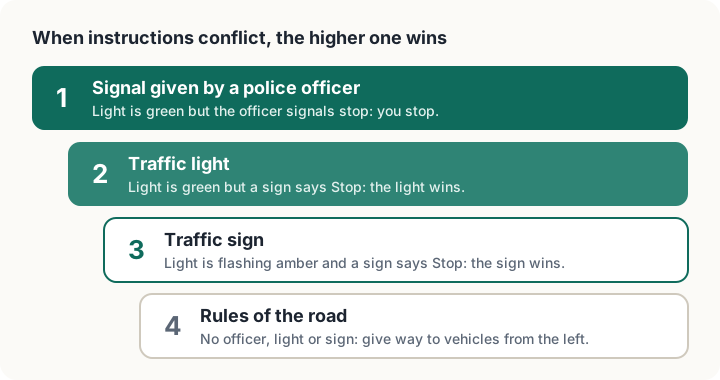
Fig. 1.3Figure 1.3Which instruction wins. Original illustration, based on Handbook §1.8, p. 24
Which instruction wins
Sometimes several instructions are given at once. Follow the highest one on this list and ignore anything lower that contradicts it.
1. Police officer: the light is green but the officer signals stop, so you stop.
2. Traffic light: the light is green but a sign says Stop, so the light wins.
3. Traffic sign: the light is flashing amber and a sign says Stop, so the sign wins.
4. Rules of the road: no officer, light or sign, so you give way to vehicles from the left.
Source: Handbook §1.8, p. 24
Rule
Signals from the police
Police usually direct traffic only when lights have failed, after an accident or at a major public event. Their signals take precedence over everything else. You must also obey the military police and anyone else officially authorised to direct traffic.
An officer raising a hand: all vehicles must stop.
A police car behind you alternately flashing blue and red lights: pull over to the side of the road and stop immediately.
A slow-down signal given from a police car: follow the police car and pull over behind it when it stops.
Source: Handbook §1.8.1, p. 25
Section 9 of 12
Give way and crossing rules
Giving way means showing it clearly and early, by slowing down or stopping in plenty of time.
Source: Handbook §1.9.1, p. 26
Animated visual · Original illustration
Giving way when you join the road
A two-way road with a car park beside it. A short driveway leads from the car park across the pavement to the road. Car A, the blue car you are driving, is in the car park, heading for the driveway. Car B and car C are on the road.
Focus the picture, then: Right arrow or N moves to the next step, Left arrow or B goes back a step. R replays from the first step. D switches between the 3D model and the 2D diagram. Comma and full stop turn the 3D model, Up and Down arrows tilt it, plus and minus zoom, 0 resets the view. Every step control also has a button.
Step 1 of 4, Leaving a car park: Car A wants to join the road from a car park. Here it must give way.
Step 1 of 4
Leaving a car park
Car A wants to join the road from a car park. Here it must give way.
Source: Handbook §1.9.1, p. 26
Steps
When you must give way
An obligation to give way means making your intention obvious by slowing or stopping in good time. Never enter a crossing if doing so might obstruct, impede or endanger other road users.
1At uncontrolled pedestrian crossings, to pedestrians who have stepped out or are about to.
2When joining the road from a parking lot, gas station, residential area, pedestrian way, hard shoulder or off-road area.
3To traffic approaching a junction or crossroads from your left.
4To oncoming traffic when you turn left, and to vehicles already on the road you are turning into.
5Whenever traffic lights or traffic signs instruct you to.
Source: Handbook §1.9.1, p. 26
Section 10 of 12
Indicators, horn, hazard lights and brake lights
Signal early and clearly. A signal never removes your responsibility.
Source: Handbook §1.10, pp. 27–29
Animated visual · Original illustration
Indicators, brake lights and hazard lights
A street with parking bays along the kerb. Car A, the blue car you are driving, stands in a bay with its left indicator on. Car D approaches from behind in the lane. Far ahead, a car has stopped in the lane.
Focus the picture, then: Right arrow or N moves to the next step, Left arrow or B goes back a step. R replays from the first step. D switches between the 3D model and the 2D diagram. Comma and full stop turn the 3D model, Up and Down arrows tilt it, plus and minus zoom, 0 resets the view. Every step control also has a button.
Step 1 of 5, Indicate before setting off: Before leaving the kerb, car A signals left in plenty of time, so the signal is clear to everyone.
Step 1 of 5
Indicate before setting off
Before leaving the kerb, car A signals left in plenty of time, so the signal is clear to everyone.
Source: Handbook §1.10.1, p. 27
Source: Handbook §1.10.2, p. 28
Source: Handbook §1.10.4, p. 29
Rule
When to indicate
Signals must be given in plenty of time and be unambiguous and clearly visible. Giving a signal does not release you from responsibility if an accident follows, so keep watching and keep showing consideration.
When you set off from the kerb or the side of the road.
When you turn off at a crossroads.
When you turn onto a road.
When you change lanes or change your position on the road.
Source: Handbook §1.10.1, p. 27
Rule
The horn is only for averting danger
Use the horn only to avert a danger, and never for longer than necessary. Sounding it does not exempt you from responsibility in a collision. Flashing your headlights or high beam means exactly the same as sounding the horn.
In residential areas you must not use the horn from midnight to 6:00 am, except to avoid danger from a moving vehicle. At night, flash your headlights instead.
Source: Handbook §1.10.2, p. 28
Rule
Hazard lights are for emergencies
Hazard lights must only be used in an emergency or accident. Using them in heavy rain as an excuse for driving fast is very dangerous and strictly forbidden.
One brief use is allowed: in a sudden traffic jam you may switch them on very briefly to tell the driver behind that they need to brake hard.
Source: Handbook §1.10.2, p. 28
Note
Brake lights as a signal
Brake lights come on as soon as you touch the pedal. Approaching an intersection, braking early shows the drivers behind what you intend. You can also tap the pedal to flash the lights at someone following too closely, or when you run into sudden congestion.
Source: Handbook §1.10.4, p. 29
Section 11 of 12
Traffic lights and other light signals
What each light means, and why a green light is still not a guarantee of safety.
Source: Handbook §1.11, pp. 29–30
Animated visual · Original illustration
What each traffic light means
A model crossroads with traffic lights and a Give Way sign. Car A, the blue car you are driving, comes from the south towards a light that shows steady amber. Car B waits on the road from the west.
Focus the picture, then: Right arrow or N moves to the next step, Left arrow or B goes back a step. R replays from the first step. D switches between the 3D model and the 2D diagram. Comma and full stop turn the 3D model, Up and Down arrows tilt it, plus and minus zoom, 0 resets the view. Every step control also has a button.
Step 1 of 5, Steady amber: Amber means stop if you can do so safely: the light is about to turn red. Car A brakes smoothly.
Step 1 of 5
Steady amber
Amber means stop if you can do so safely: the light is about to turn red. Car A brakes smoothly.
Source: Handbook §1.11, p. 30
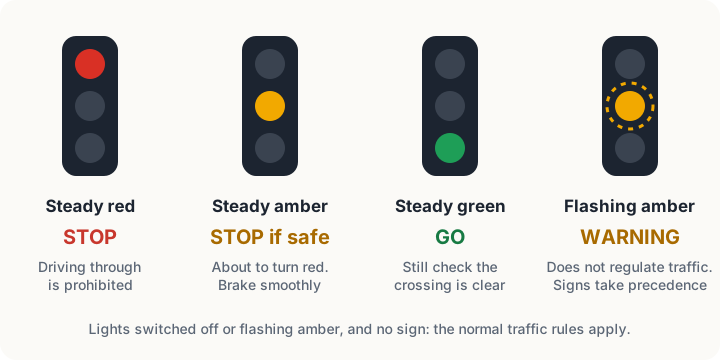
Illustrated
Fig. 1.4Figure 1.4What each light means. Original illustration, based on Handbook §1.11, p. 30
What each light means
Many accidents still happen at light-controlled crossings, so proceed with caution even on green, and make doubly sure the road really is clear before you turn.
Steady red: stop. Driving through a red light is prohibited.
Steady green: go.
Steady amber: stop if you can do so safely. The light is about to turn red, so brake smoothly.
Flashing amber: a warning only. It does not regulate traffic, so traffic signs take precedence. The same applies if the lights are switched off.
No sign either: the normal traffic rules apply.
Source: Handbook §1.11, p. 30
Note
Other light signals
Not every light signal is a standard three-colour traffic light.
Pedestrian lights: when you turn into another road the pedestrian light may be green. If so, you must give way.
One flashing amber light, or two flashing alternately: danger, take extra care. Often used at a pedestrian crossing or beside a warning sign.
Lane control signs above a lane: a red cross means the lane is closed.
Alternately flashing red lights, for example at a fire station: stop.
Source: Handbook §1.11, p. 30
Note
Which light applies to you
A light or give-way sign placed on the right-hand side just before the crossing will nearly always apply to you. If you are in a lane reserved for turning left, the light with the green arrow filter is often placed on the left of the carriageway instead.
Source: Handbook §1.11, p. 29
Section 12 of 12
Defensive driving
Predict risks before they become emergencies, and allow for other people’s mistakes.
Source: Handbook §1.12, p. 31
Animated visual · Original illustration
Driving defensively
A long straight road with two lanes heading east. Car A, the blue car you are driving, is in the right-hand lane behind car B, with car C following. Further along, a child stands on the pavement beside the road.
Focus the picture, then: Right arrow or N moves to the next step, Left arrow or B goes back a step. R replays from the first step. D switches between the 3D model and the 2D diagram. Comma and full stop turn the 3D model, Up and Down arrows tilt it, plus and minus zoom, 0 resets the view. Every step control also has a button.
Step 1 of 5, Think ahead: Car A’s driver stays alert and looks well down the road, not only at the car in front.
Step 1 of 5
Think ahead
Car A’s driver stays alert and looks well down the road, not only at the car in front.
Source: Handbook §1.12, p. 31
Steps
How to drive defensively
Defensive driving means being aware of the risks at all times and doing your best to prevent accidents. It includes showing consideration to road users who know the road less well than you, and respecting unprotected road users. It takes practice, experience and imagination.
1Think ahead and stay alert to what is going on around you.
2Observe actively and recognise hazards.
3Keep a safe following distance.
4Position safely and keep to the correct lane.
5Drive at the correct speed and brake in good time.
6Check your rear-view mirror frequently, and check the road before setting off.
Source: Handbook §1.12, p. 31
Chapter 1 recap
Remember this
Triangle warns, blue circle instructs, red circle prohibits, orange background is temporary.
Broken lines advise; continuous lines prohibit. The more paint, the more important the message.
No officer, light, sign or marking at a junction: give way to vehicles from your left.
Turning left: give way to oncoming vehicles and to pedestrians crossing your path.
Precedence: police officer, then traffic light, then sign, then rules of the road.
Steady amber means stop if you can do so safely; flashing amber is only a warning.
Horn and headlight flash are only for averting danger; hazard lights only for emergencies.
Giving a signal never removes your responsibility.
Common misconceptions
Myth
: A green light means it is safe to go.
Fact
: Green means go, but the handbook stresses that many accidents still happen at light-controlled crossings. Proceed with caution and make sure the crossing is actually clear.
Source: Handbook §1.11, p. 29
Myth
: Once I have indicated, other drivers have to let me in.
Fact
: A signal only announces your intention. It does not release you from responsibility if an accident happens.
Source: Handbook §1.10.1, p. 27
Myth
: Hazard lights make it safer to keep up speed in heavy rain.
Fact
: Using hazard lights in heavy rain as an excuse for high speed is described as very dangerous and strictly forbidden. They are for emergencies and accidents.
Source: Handbook §1.10.2, p. 28
Myth
: A crossing with a flashing amber signal is a controlled crossing.
Fact
: Only crossings controlled by a police officer or a traffic light count as controlled. A crossing with a flashing amber signal is still uncontrolled.
Source: Handbook §1.7.1, p. 23
Myth
: If a sign says Stop but the traffic light is green, I should stop.
Fact
: A working traffic light takes precedence over a traffic sign. The sign only takes over when the light is flashing amber or switched off.
Source: Handbook §1.8, p. 24
Chapter 1 · practice
Check your knowledge
6 quick questions on this chapter, with an explanation after each answer. Or practise all 23 questions written for it.